MCQ
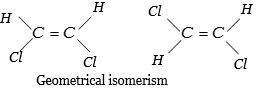
$1, 2-$Dichloroethene shows
- ✓Geometrical isomerism
- BOptical isomerism
- CRing-chain isomerism
- DResonance
Generate a complete, print-ready paper with questions like this in minutes — across 16+ boards, with answer keys.
$CH _{3} OH (1)+\frac{3}{2} O _{2}( g ) \rightarrow CO _{2}( g )+2 H _{2} O (1)$
the amount of heat produced as measured by bomb calorimeter is $726 \,kJ\, mol ^{-1}$ at $27^{\circ} C$. The enthalpy of combustion for the reaction is $- x \,kJ\,mol ^{-1}$, where $x$ is $.....$ (Nearest integer)
$\left(\right.$ Given $: R =8.3\, J\,K ^{-1} \,mol ^{-1}$ )
$\begin{array}{*{20}{c}}
{\,\,\,\,\,\,\,O} \\
{\,\,\,\,\,\,\,\,||} \\
{C{H_3} - C - H}
\end{array}$ $\mathop {\xrightarrow{{HCN}}}\limits_{\mathop O\limits^\Theta H} (A)\mathop {\xrightarrow{{{H_2}O/{H^ \oplus }}}}\limits_\Delta $ Product
Product will be :
| Column $I$ | Column $II$ |
| $(A)$ $CH_3COONa$ | $(i)$ Almost neutral, $pH > 7$ or $< 7$ |
| $(B)$ $NH_4Cl$ | $(ii)$ Acidic, $pH < 7$ |
| $(C)$ $NaNO_3$ | $(iii)$ Alkaline, $pH > 7$ |
| $(D)$ $CH_3COONH_4$ | $(iv)$ Neutral, $pH = 7$ |
