MCQ
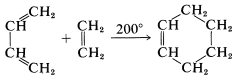
$1, 3-$butadiene reacts with ethylene to form
  • A
    Benzene
  • B
    Cyclohexane
  • Cyclohexene
  • D
    $2, 3$ dimethyl butane

Answer

Correct option: C.
Cyclohexene
c
the addition of ethene to $1,3$-butadiene to give cyclohexene.

Need a full question paper?

Generate a complete, print-ready paper with questions like this in minutes — across 16+ boards, with answer keys.

Start Generating Free

Similar questions

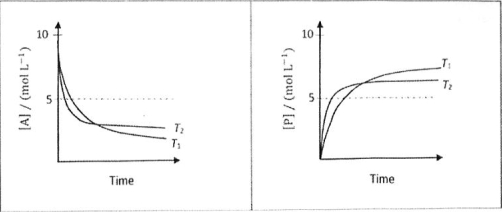
For a reaction, $A \rightleftharpoons P$, the plots of $[ A ]$ and $[ P ]$ with time at temperatures $T _1$ and $T _2$ are given below.

If $T _2> T _1$, the correct statement(s) is (are)

(Assume $\Delta H ^{\ominus}$ and $\Delta S ^{\ominus}$ are independent of temperature and ratio of $\ln K$ at $T _1$ to $\ln K$ at $T_2$ is greater than $T_2 / T_1$. Here $H, S, G$ and $K$ are enthalpy, entropy, Gibbs energy and equillibrium constant, respectively.)

$(A)$ $\Delta H ^{\ominus}<0, \Delta S ^{\ominus}<0$  $(B)$ $\Delta G ^{\ominus}<0, \Delta H ^{\ominus}>0$  $(C)$ $\Delta G ^{\ominus}<0, \Delta S ^{\ominus}<0$  $(D)$ $\Delta G ^{\ominus}<0, \Delta S ^{\ominus}>0$
Standard free energies of formation (in $kJ/mol$) at $298\, K$ are $-237.2, -394.4$ and $-8.2 $ for $H_2O_{(l)} , CO_{2(g)}$ and pentane$_{(g)}$ respectively. The value of $E^o_{cell}$ for the pentane-oxygen fuel cell is .......... $V$.
Assign $A, B, C, D$ from given type of reaction. $(NH_4)_2 Cr_2O_7 \xrightarrow{\Delta }N_2  \uparrow  + Cr_2O_3   \downarrow   + H_2O   \uparrow  $
The de Broglie wavelength of an electron in the $4^{th}$ Bohr orbit is
The ratio of area covered by second orbital to the first orbital is
$2-$ Hexyne gives trans $-2-$ Hexene on treatment with :
The total number of benzene derivatives with molecular formula $C_6H_3Cl_3$ is
$750$ waves of a energy radiation passes in one minute from a point then what will be wavelength of radiation
The compound $B$ formed in the following sequences of reactions is

$C{H_3}C{H_2}C{H_2}OH \xrightarrow{PCl_3}A\xrightarrow{Alco.KOH}B$

For which of the following reactions does the equilibrium constant depend on the units of concentration