MCQ
$1 \,amu$ is equal to
  • $\frac{1}{{12}}{\rm{\,of \,}}C - 12$
  • B
    $\frac{1}{{14}}{\rm{\,of \, O - 16}}$
  • C
    $1\,g\,{\rm{ \,of \,}}{H_2}$
  • D
    $1.66 \times {10^{ - 23}}\,kg$

Answer

Correct option: A.
$\frac{1}{{12}}{\rm{\,of \,}}C - 12$
a
because $amu$ is a unit crreated eith refernce to $1 / 12$ to that of carbon

Need a full question paper?

Generate a complete, print-ready paper with questions like this in minutes — across 16+ boards, with answer keys.

Start Generating Free

Similar questions

When $KMn{O_4}$ reacts with acidified $FeS{O_4}$
The main product of reaction alcoholic silver nitrite and ethyl bromide. is
Which of the following complex shows ionization isomerism
Which one of the following compounds is not coloured
Consider an electrochemical cell: $A ( s )\left| A ^{ n +}( aq , 2 M ) \| B ^{2 n +}( aq , 1 M )\right| B ( s )$. The value of $\Delta H ^{\ominus}$ for the cell reaction is twice that of $\Delta G ^{\ominus}$ at $300 K$. If the emf of the cell is zero,  the $\Delta S ^{\ominus}$ (in $J K ^{-1} mol ^{-1}$ ) of the cell reaction per mole of $B$ formed at $300 K$ is. . . . . . . (Given: $\ell n (2)=0.7, R$ (universal gas constant) $=8.3 J K ^{-1} mol ^{-1} . H , S$ and $G$ are enthalpy, entropy and Gibbs energy, respectively.)
If $Br^-$ configuration is $[Ar]\, 3d^{10}\,4s^2\,4p^6$ then $Br^{+2}$ configuration will be identical to which element ?
The correct order of increasing bond angles is
Which of the following units represents the largest amount of energy
$C{H_3} - C \equiv C - C{H_3}\xrightarrow[\Delta ]{{{H^ \oplus }/KMn{O_4}}}A\xrightarrow[{(2)\,{H^ \oplus }}]{{(1)\,LiAl{H_4}}}B$

$B$ will be

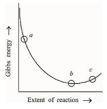
Consider the graph of $G i b b s$ free energy $G$ vs Extent of reaction. The number of statement/s from the following which are true with respect to points $(a), (b)$ and $(c)$ is $.................$

$A.$Reaction is spontaneous at $(a)$ and $(b)$

$B.$Reaction is at equilibrium at point $(b)$ and nonspontaneous at point $(c)$

$C.$Reaction is spontaneous at $(a)$ and nonspontaneous at $(c)$

$D.$Reaction is non-spontaneous at $(a)$ and $(b)$