Question
1 eV energy is equivalent to how many joules?

Answer

$1.6 \times 10^{-19}$ Joules.

Need a full question paper?

Generate a complete, print-ready paper with questions like this in minutes — across 16+ boards, with answer keys.

Start Generating Free

Similar questions

Is it necessary to express all angles in radian while using the equation $\omega=\omega_0+\text{at}?$
Can the image formed by a simple microscope be projected on a screen without using any additional lens or mirror?
Galileo was punished by the Church for teaching that the sun is stationary and the earth moves around it. His opponents held the view that the earth is stationary and the sun moves around it. If the absolute motion has no meaning, are the two, viewpoints not equally correct or equally wrong?
Suppose that the lower half of the concave mirror's reflecting surface in Fig. 9.6 is covered with an opaque (non-reflective) material. What effect will this have on the image of an object placed in front of the mirror?
What is the amount of work done in moving a point charge Q around a circular arc of radius ‘r' at the centre of which another point charge ‘q' is located?
An AC source is connected to a capacitor. Will the rms current increase, decrease or remain constant if a dielectric slab is inserted into the capacitor?
A brick weighing 4.0kg is dropped into a 1.0m deep river from a height of 2.0m. Assuming that 80% of the gravitational potential energy is finally converted into thermal energy, find this thermal energy is calorie.
When an electric dipole is placed in a non- uniform electric field, does it experience a force?
Magnetic scalar potential is defined as

$\text{U}(\overrightarrow{\text{r}_2})-\text{U}(\overrightarrow{\text{r}_1})=-\int\limits^{\vec{\text{r}}_2}_{\vec{\text{r}_1}} \vec{\text{B}}.\text{d}\vec{\text{l}}.$

Apply this equation to a closed curve enclosing a long atraicht wire. The RHS of the above equation is then $-{\mu}_\text{o} \text{ i}$ by Ampere's law. We see that $\text{U}(\vec{\text{r}_2})\neq\text{U}(\vec{\text{r}_1})$ even when $\vec{\text{r}_2}=\vec{\text{r}_1}.$Can we have a magnetic acalar potential in this case?
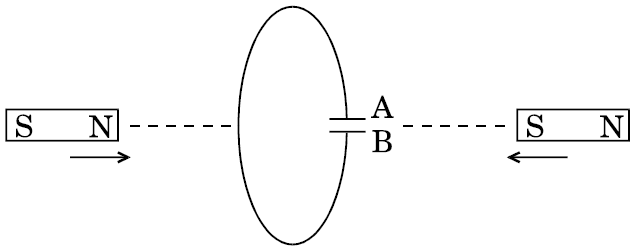
Predict the polarity of the capacitor in the situation described below: