Question
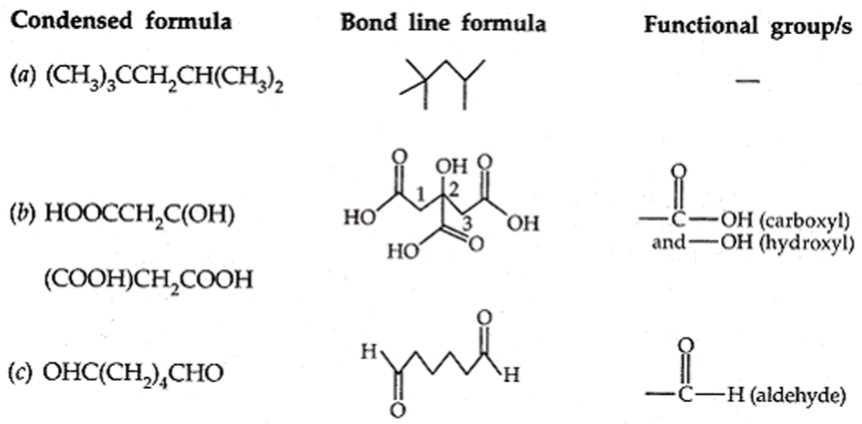
1. Give condensed and bond line structural formulas and identify the functional groups present, if any, for:
a. 2, 2, 4-Trimethylpentane
b. 2-Hydroxy-1, 2, 3-propanetricarboxylic acid
c. Hexanedial?
2. Give three points of differences between inductive effect and resonance effect.
Answer

1.
Image
2.
S.No.Inductive effectResonance effect
1.It involves displacement of σ electrons in saturated compounds.It involves displacement of $\pi$ electrons or lone pair of electrons in unsaturated and conjugated compounds.
2.Inductive effect can move only upto 3 to 4 carbons.In this case, movement of electrons all along the length of conjugated system takes place.
3.In inductive effect, there is slight displacement of $\sigma$ electrons and partial +ve or-ve charge develops.In this effect, there is complete transfer of $\pi$ electrons and as a result, complete +ve or -ve charge develops.

Need a full question paper?

Generate a complete, print-ready paper with questions like this in minutes — across 16+ boards, with answer keys.

Start Generating Free

Similar questions

A sample of 0.50g of an organic compound was treated according to Kjeldahl’s method. The ammonia evolved was absorbed in 50ml of 0.5M H2SO4. The residual acid required 60mL of 0.5M solution of NaOH for neutralisation. Find the percentage composition of nitrogen in the compound.
Balance the following equations in basic medium by ion-electron method and oxidation number methods and identify the oxidising agent and the reducing agent.

Cl2O7(g) + H2O2(aq) → ClO2-(aq) + O2(g) + H+

Attempt any five of the following:
1. Convert methane into ethane.
2. Write IUPAC name of the following: $CH _3\left( CH _2\right)_4 CH \left( CH _2\right)_3 CH _3 CH _2- CH \left( CH _3\right)_2$
3. To which category of compounds does cyclohexane belong?
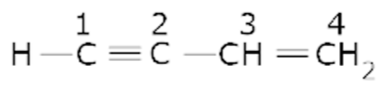
4. Name the type of hybridization in C (2) and C (3) in the following molecule
Image

5. What are Arenes?
6. n-propylmagnesium bromide on hydrolysis gives propane. Is there any other Grignard reagent which also gives propane? If so, give its name, structure and equation for the reaction.
7. How will you distinguish between acetylene and ethylene?
How do atomic radius vary in a period and in a group? How do you explain the variation?
The solubility product of AgCl is 1.5 × 10⁻¹⁰. Predict whether there will be any precipitation by mixing 50mL of 0.01M NaCl and 50mL of 0.01M AgNO3 solution.
What is the difference between distillation, distillation under reduced pressure and steam distillation?
  1. Predict the sign of the entropy change for each of the following changes:
  1. Hg(l) → Hg(g)
  2. Steam → Water
  1.  
  1. Define Gibb's Energy. Give its mathematical expression. What is Gibb's energy criteria for spontaneity.
  2. Give a brief note on the following thermodynamic terms:
  • Standard enthalpy of combustion.
  • Standard enthalpy of formation.
A compound on analysis found to contain following percentage composition:
Na = 43.4%, C = 11.4% and O = 45.3%. Determine the empirical and molecular formulae.
Given: the relative molecular mass of the compound is 106.
Calculate the enthalpy change for the process

$\text{CCI}_4(\text{g})\xrightarrow{ \ \ \ \ \ }\text{C}(\text{g})+4\text{CI}(\text{g})$

and calculate bond enthalpy of C – Cl in CCl4(g).

$\Delta_\text{vap}\text{H}^\ominus(\text{CCI}_4)=30.5\text{kJ} \ \text{mol}^{-1}.$

$\Delta_\text{f}\text{H}^\ominus(\text{CCI}_4)=-135.5\text{kJ} \ \text{mol}^{-1}.$

$\Delta_\text{a}\text{H}^\ominus(\text{C})=-715.0\text{kJ} \ \text{mol}^{-1},$ where $\Delta_\text{a}\text{H}^\ominus$ is enthalpy of atomisation

$\Delta_\text{a}\text{H}^\ominus(\text{CI}_2)=242\text{kJ} \ \text{mol}^{-1}$

0.2325g of an organic compound was analysed for nitrogen by Duma's method 0.0317L of moist nitrogen was collected at 25°C and 755.8mm pressure. Calculate the percentage of nitrogen. [Aq. tension of water at 25°C is 23.8mm Hg.)