Question
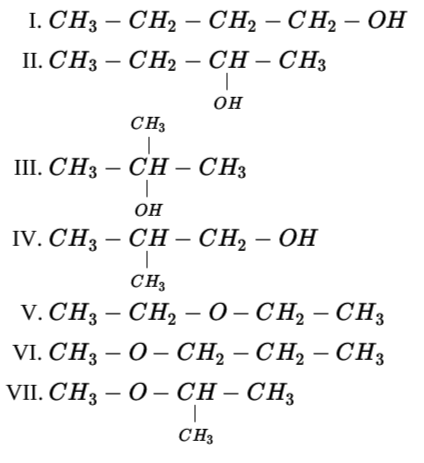
1. Identify the pairs of compounds which are functional group isomers.
Image
2. Explain, how is the electronegativity of carbon atoms related to their state of hybridization in an organic compound.

Answer

1. All the seven compounds given have the same molecular formula, so each alcohol is a functional group isomer of each ether given and visa-versa. Functional group isomers are a type of structural isomers having the same molecular formula but different functional groups. In the given structures, I, II, III, IV represent alcohols and V, VI, VII are ethers. Hence, I and V, I and VI, I and VII, II and V, II and VI, II and VII, III and V, III and VI, etc.
2. If C is sp hybridized then S character is $50 \%$.
If C is $sp ^2$ hybridized then S character is $33 \%$.
If C is $sp ^3$ hybridized then S character is $25 \%$.
Electronegativity of carbon is directly proportional to ' $s$ ' character.
Hence, sp hybridized carbon has strong S character.
We know that, s electrons are more strongly attracted by nucleus than p-electrons as they lie closer to nucleus.. Thus, electronegativity of carbon increases with increase in ' $s$ ' character.

Need a full question paper?

Generate a complete, print-ready paper with questions like this in minutes — across 16+ boards, with answer keys.

Start Generating Free

Similar questions

What are the major differences between metals and non-metals?
Choose the correct answer.
The enthalpy of combustion of methane, graphite and dihydrogen at 298K are, –890.3kJ mol–1 –393.5kJ mol–1, and –285.8kJ mol–1 respectively. Enthalpy of formation of CH4(g) will be:
  1. –74.8kJ mol–1
  2. –52.27kJ mol–1.
  3. +74.8kJ mol–1.
  4. +52.26kJ mol–1.
  1. Show that the circumference of Bohr's orbit for the H-atom is an integral multiple of the de-Broglie wavelength of electron revolving around the orbit.
  2. Explain that the effect of the Heisenberg uncertainty principle is significant only for motion of microscopic objects and is negligible for that of macroscopic objects. [h = 6.626 × 10⁻³⁴Js, Mass of electron = 9.1 × 10⁻³¹kg].
  3. State Hund's Rule of maximum multiplicity.
At 450K, Kp= 2.0 × 10¹⁰/bar for the given reaction at equilibrium.
$2\text{SO}_2\text{(g) + O}_2\text{(g)}\rightleftharpoons\text{2SO}_3\text{(g)}$
What is Kc at this temperature?
If the density of methanol is 0.793kg L–1, what is its volume needed for making 2.5L of its 0.25M solution?
Determine the molecular formula of an oxide of iron, in which the mass per cent of iron and oxygen are 69.9 and 30.1, respectively.
Note: Given that the molar mass of the oxide is 159.69g mol-1
In what manner is the long form of periodic table better than Mendeleev’s periodic table? Explain with examples.
Explain different types of isomerism in alkenes with example.
Briefly describe the valence bond theory of covalent bond formation by taking an example of hydrogen. How can you interpret energy changes taking place in the formation of dihydrogen?
The first ionization constant of $H _2 S$ is $9.1 \times 10^{-8}$. Calculate the concentration of $HS ^{-}$ion in its 0.1 M solution. How will this concentration be affected if the solution is 0.1 M in HCl also? If the second dissociation constant of $H _2 S$ is $1.2 \times 10^{-13}$, calculate the concentration of $S ^{2-}$ under both conditions.