Question
1. The fact that the enthalpy is a state function forms the basis of a very useful law. Name the law.
2. Two liters of an ideal gas at a pressure of 10 atm expands isothermally at $25^{\circ} C$ into a vacuum until its total volume is 10 liters. How much heat is absorbed and how much work is done in the expansion?
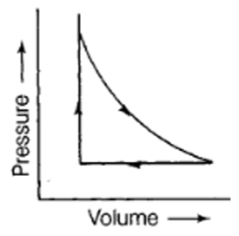
3. A sample of 1.0 mole of a monoatomic ideal gas is taken through a cyclic process of expansion and compression as shown in the figure. What will be the value of $\Delta H$ for the cycle as a whole?
Image

Answer

1. The name of the law is Hess's law of heat summation.
2. We have $q =- w = p _{ ex }(10-2)=0(8)=0$ No work is done; no heat is absorbed.
3. According to the question, 1 mole of a mono atomic ideal gas is taken through a cyclic process of expansion and compression.
Image
$\Delta H$ for a cyclic process is zero because enthalpy change is a state function.

Need a full question paper?

Generate a complete, print-ready paper with questions like this in minutes — across 16+ boards, with answer keys.

Start Generating Free

Similar questions

Calculate the atomic mass (average) of chlorine using the following data:
 
% Natural Abundance
Molar Mass
${ }^{35} \mathrm{Cl}$
75.77
34.9689
${ }^{35} \mathrm{Cl}$
24.23
36.9659
Name the following:
  1. The crystalline form of silica used in modern radio and T.V. broad casting and mobile radio communication.
  2. The oxides of carbon which form a complex with haemoglobin 300 times more faster than oxygen.
  3. Allotropes of carbon which has $\Delta_\text{f}\text{H}^\ominus=0$
  4. A type of polymer is semiorganic in nature.
  5. Two man-made silicate.
Standard molar enthalpy of formation, $\Delta_\text{f}\text{H}^\ominus$ is just a special case of enthalpy of reaction, $\Delta_\text{r}\text{H}^\ominus$. Is the $\Delta_\text{r}\text{H}^\ominus$ for the following reaction same as $\Delta_\text{f}\text{H}^\ominus$? Give reason for your answer.$\text{CaO}(\text{s})+\text{CO}_2(\text{g})\rightarrow\text{CaCO}_3(\text{s});$ $\Delta_\text{f}\text{H}^\ominus=-178.3\text{kJ}\ \text{mol}^{-1}$
The value of $\Delta_\text{f}\text{H}^\ominus$ for $NH_3$ is $-91.8kJ mol^{-1}$. Calculate enthalpy change for the following reaction:$2\text{NH}_3(\text{g})\rightarrow\text{N}_2(\text{g})+3\text{H}_2(\text{g})$
1 M solution of $\mathrm{NaNO}_3$ has density $1.25 \mathrm{~g} \mathrm{~cm}^{-3}$. Calculate its molality.
(Mol. weight of $\mathrm{NaNO}_3=85 \mathrm{~g} \mathrm{~mol}^{-1}$ )
Consider the reactions:$2\text{S}_2\text{O}^{2-}_{3}(\text{aq})+\text{I}_2(\text{s})\rightarrow\text{S}_4\text{O}^{2-}_{6}(\text{aq})+2\text{I}^{-}(\text{aq})$
$\text{S}_2\text{O}^{2-}_{3}(\text{aq})+2\text{Br}_2(\text{l})+5\text{H}_2\text{O(l)}\rightarrow\\2\text{SO}^{2-}_{4}(\text{aq})+4\text{Br}^{-}(\text{aq})+10\text{H}^+(\text{aq})$
Why does the same reductant, thiosulphate react differently with iodine and bromine?
Account for the following observations:
Though fluorine is more electronegative than chlorine yet $\mathrm{BF}_3$ is a weaker Lewis acid than $\mathrm{BCl}_3$
1. Two litres of an ideal gas at a pressure of 10 atm expands isothermally at $25^{\circ} C$ into a vacuum until itstotal volume is 10 litres. How much heat is absorbed and how much work is done in the expansion against a constant external pressure of 1 atm?
2. What is free energy in terms of thermodynamics?
3. Define a system.
Mention the various sources of sodium chloride and explain the preparation of sodium chloride from sea-water and salt mines.
The mass of an electron is $9.1 \times 10^{-31} \mathrm{~kg}$. If its K.E. is $3.0 \times 10^{-25} \mathrm{~J}$, calculate its wavelength.
The electronic configuration of some elements are given below:
a. $1 s^2, 2 s^2, 2 p^6, 3 s^2$
b. $1 s^2, 2 s^2, 2 p^6$
c. $1 s^2, 2 s^2, 2 p ^2$
d. $1 s^2, 2 s^2, 2 p ^6, 3 s^1$
e. $1 s^2, 2 s^2, 2 p^5$
Answer the following questions:
i. Name the elements.
ii. Which of these have the lowest Ionization enthalpy?
iii. Which is a halogen?
iv. Which is an alkali metal?
v. Which is an inert gas?