$10$ wires (same length, same area, same material) are connected in parallel and each has $1$ $\Omega$ resistance, then the equivalent resistance will be .............. $\Omega$
Easy


Download our appand get started for free
Experience the future of education. Simply download our apps or reach out to us for more information. Let's shape the future of learning together!No signup needed.*
Similar Questions
- 1A battery of $24$ cells, each of emf $1.5\, V$ and internal resistance $2\, \Omega$ is to be connected in order to send the maximum current through a $12 \,\Omega$ resistor. The correct arrangement of cells will beView Solution
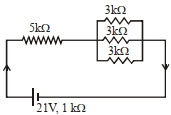
- 2In the figure given, the electric current flowing through the $5\, k \Omega$ resistor is $'x' mA.$View Solution
The value of $x$ to the nearest integer is .........
- 3The resistance of a wire is $R$. It is bent at the middle by $180^{\circ}$ and both the ends are twisted together to make a shorter wire. The resistance of the new wire isView Solution
- 4View SolutionThe colour sequence in a carbon resistor is red, brown, orange and silver. The resistance of the resistor is
- 5Resistance of $100\, cm$ long potentiometer wire is $10 \,\Omega$, it is connected to a battery ($2\, volt$) and a resistance $R$ in series. A source of $10\, mV$ gives null point at $40\, cm$ length, then external resistance $R$ is ........... $\Omega $View Solution
- 6A uniform heating wire of resistance $36\, \Omega$ is connected across a potential difference of $240\, {V}$ The wire is then cut into half and potential difference of $240\, {V}$ is applied across each half separately. The ratio of power dissipation in first case to the total power dissipation in the second case would be $1: {x}$, where ${x}$ is........... .View Solution
- 7$32$ cells, each of $emf$ $3V$, are connected in series and kept in a box. Externally, the combination shows an $emf$ of $84\, V$. The number of cells reversed in the combination isView Solution
- 8If three resistors of resistance $2 \,\Omega$, $4 \,\Omega$ and $5 \,\Omega$ are connected in parallel then the total resistance of the combination will beView Solution
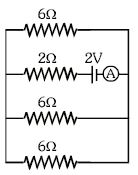
- 9The ammeter reading in the following circuit will be .............. $A$View Solution
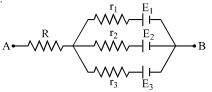
- 10In the network shown the potential difference between $A$ and $B$ is ................. $V$ $(R = r_1 = r_2 = r_3 = 1 \Omega$ ,$ E_1 = 3\, V, E_2 = 2\, V, E_3 = 1\, V)$View Solution