Question
Image

Answer

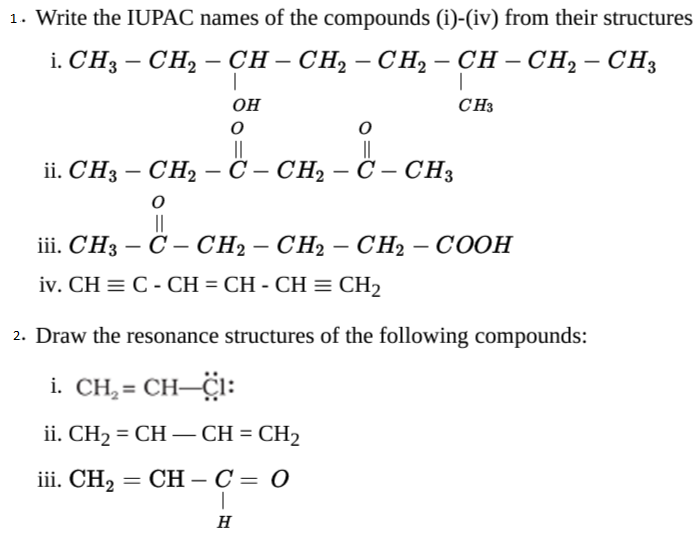
1. i. 6-methyl octan-3-ol,
ii. Hexane-2,4-dione,
iii. 5-oxohexanoic acid,
iv. Hexa-1, 3-dien-5-yne
2. Resonance structure of the given compounds are as follows:

Need a full question paper?

Generate a complete, print-ready paper with questions like this in minutes — across 16+ boards, with answer keys.

Start Generating Free

Similar questions

1. During estimation of nitrogen present in an organic compound by Kjeldahl's method, the ammonia evolved from 0.5 g of the compound in Kjeldahl's estimation of nitrogen, neutralized 10 mL of $1 M H _2 SO _4$. Find out the percentage of nitrogen in the compound.
2. Explain why $\left( CH _3\right)_3 \stackrel{+}{ C }$ is more stable than $CH _3 \stackrel{+}{ C } H _2$ and $\stackrel{+}{ C } H _3$ is the least stable cation.
Explain why the following compounds behave as Lewis acids?
  1. $BCl_3$.
  2. $AlCl_3$.
What do you understand by following?
  1. Dissociation constant of an acid.
  2. Buffer solution.
  3. Solubility product.
All transition elements are d-block elements, but all d-block elements are not transition elements. Explain.
1. a. Define the following terms:
i. Enantiomers
ii. Racemic mixture
b. Why is chlorobenzene resistant to nucleophilic substitution reaction?
2. What is the general molecular formula of saturated monohydric alcohols?
Write the mechanism of reaction of propene and HBr in presence of peroxide.
Calculate the oxidation number of each sulphur atom in the following compounds :
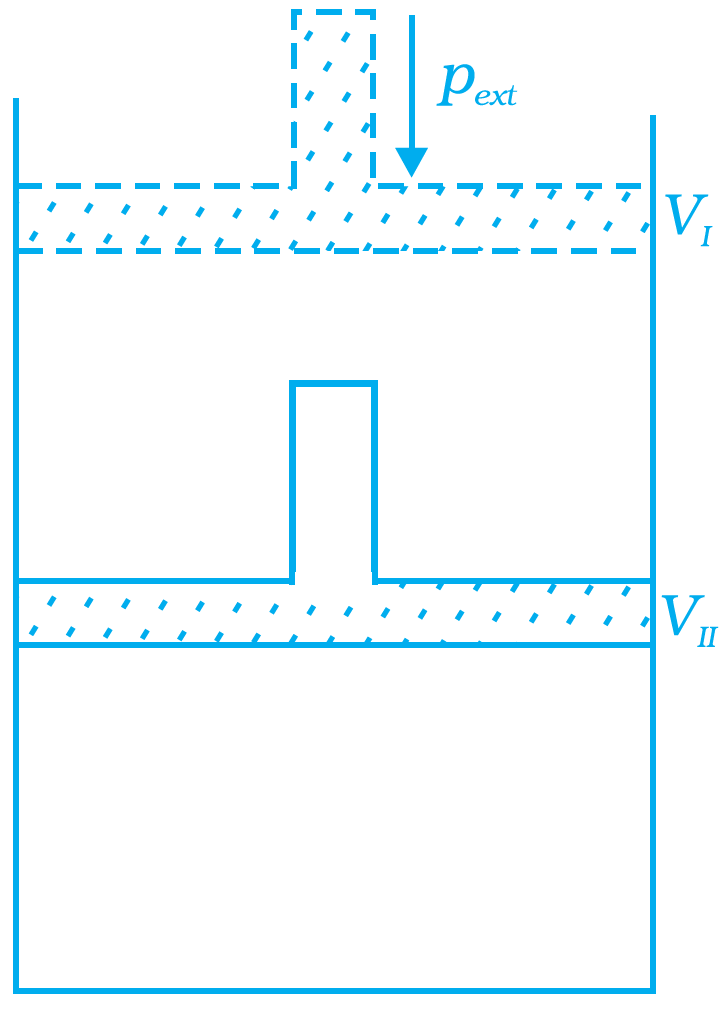
What will be the work done on an ideal gas enclosed in a cylinder, when it is compressed by a constant external pressure, $p_{ext}$​​​​​​​ in a single step as shown in Fig. Explain graphically.
The solubility product constant of $\mathrm{Ag}_2 \mathrm{CrO}_4$ and AgBr are $1.1 \times 10^{-12}$ and $5.0 \times 10^{-13}$ respectively. Calculate the ratio of the molarities of their saturated solutions.
Explain the shapes of different atomic orbitals.