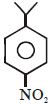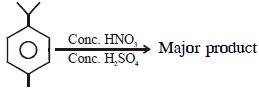
MCQ
$\,$
  • A


  • C

  • D

Answer

Correct option: B.

b

Need a full question paper?

Generate a complete, print-ready paper with questions like this in minutes — across 16+ boards, with answer keys.

Start Generating Free

Similar questions

The $2\,N$ aqueous solution of ${H_2}S{O_4}$ contains
Which one has the highest percentage of nitrogen
Given

$\left( i \right)\,2F{e_2}{O_3}\left( s \right) \to 4Fe\left( s \right) + 3{O_2}\left( g \right)$

         ${\Delta _r}{G^o} =  + 1487.0\,kJ\,mo{l^{ - 1}}$

$\left( {ii} \right)\,2CO\left( g \right) + {O_2}(g) \to 2C{O_2}\left( g \right)$

        ${\Delta _r}{G^o} =  - 514.4\,kJ\,mo{l^{ - 1}}$

Free energy change, $\Delta_rG^o$  for the reaction

$\,2F{e_2}{O_3}\left( s \right) + 6CO\left( g \right) \to 4Fe\left( s \right) + 6C{O_2}\left( g \right)$ will be .....$kJ\, mol^{-1}$

The intermediate during the addition of $HCl$ to propene in the presence of peroxide is
On dissolving $0.5 g$ of a non-volatile non-ionic solute to $39 g$ of benzene, its vapor pressure decreases from $650 mm Hg$ to $640 mm Hg$. The depression of freezing point of benzene (in $K$ ) upon addition of the solute is. . . . .

(Given data : Molar mass and the molal freezing point depression constant of benzene are $78 g mol ^{-1}$ and $5.12 K kg mol ^{-1}$, respectively)

In which of the following reactions hydrogen gas will not be evolved ?
Among $\mathrm{H}_2, \mathrm{He}_2^{+}, \mathrm{Li}_2, \mathrm{Be}_2, \mathrm{~B}_2, \mathrm{C}_2, \mathrm{~N}_2, \mathrm{O}_2^{-}$, and $\mathrm{F}_2$, the number of diamagnetic species is (Atomic numbers: $\mathrm{H}=1, \mathrm{He}=2, \mathrm{Li}=3, \mathrm{Be}=4, \mathrm{~B}=5, \mathrm{C}=6, \mathrm{~N}=7, \mathrm{O}=8, \mathrm{~F}=9$ )
Which of the following basic amino acid is least basic
For the reaction $A \to B$, the rate law expression is : Rate $ = \,k\,[A]$ Which of the following statements is incorrect
If $p$ is the momentum of the fastest electron ejected from a metal surface after the irradiation of light having wavelength $\lambda $, then for $1.5\, p$ momentum of the photoelectron, the wavelength of the light should be: (Assume kinetic energy of ejected photoelectron to be very high in comparison to work function)