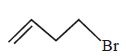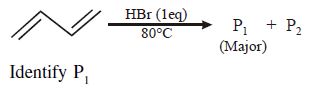
MCQ
$\,$
  • A


  • C

  • D

Answer

Correct option: B.

b
At higher temperature thermodyanamically controlled product will be favoured. ($1,4\,-$ addition)

Need a full question paper?

Generate a complete, print-ready paper with questions like this in minutes — across 16+ boards, with answer keys.

Start Generating Free

Similar questions

Solid $KClO_3$ is taken in a container maintained at constant pressure of $1\,atm$. Upon heating following equilibrium is obtained
$2KCl{O_3}\left( s \right){\text{ }} \rightleftharpoons \,\,2KCl\left( s \right){\text{ }} + {\text{ }}3{O_2}\left( g \right)$

If $\Delta H^o = 25\,kcal/mol$ and $\Delta S^o = 50\,cal/K,$ at what temperature equilibrium will be established in the container. (Ignore variation of $\Delta H^o$ and $\Delta S^o$ with temperature.).......$K$

Which phrase would be incorrect to use
An element ' $E$ ' has the ionisation enthalpy value of $374 \mathrm{~kJ} \mathrm{~mol}^{-1}$. 'E' reacts with elements A, B, C and D with electron gain enthalpy values of $-328,-349$, -325 and $-295 \mathrm{~kJ} \mathrm{~mol}^{-1}$, respectively.
The correct order of the products EA, EB, EC and ED in terms of ionic character is :
Consider the following reaction :

$A +$ alkali $\rightarrow B$ (Major Product)

If $B$ is an oxoacid of phosphorus with no $P - H$ bond, then $A$ is ..... .

When a chemical bond is formed, there is decrease in
Which of the following compound will not undergo tautomerism?
If two substances $A$ and $B$ have $P_A^0:\,P_B^0 = 1\,:\,2$ and have mole fraction in solution $1 : 2 $ then mole fraction of $A$ in vapours
Consider the following statements

$(a)$ The $pH$ of a mixture containing $400\, mL$ of $0.1\, M\, H_2SO_4$ and $400\, mL$ of $0.1\, M\, NaOH$ will be approximately $1.3$.

$(b)$ Ionic product of water is temperature dependent.

$(c)$ A monobasic acid with $K_a = 10^{-5}$ has a $pH = 5$. the degree of dissociation of this acid is $50\%$.

$(d)$ The Le Chatelier’s principle is not applicable to common-ion effect.

The correct statements are:

The incorrect statement is / are
If a reaction has the experimental rate expression rate $= K [A]^2[B]$, if the concentration of $A$ is doubled and the concentration of $B$ is halved, the what happens to the reaction rate