MCQ
$ \, $
  • A

  • B

  • C


Answer

Correct option: D.

d
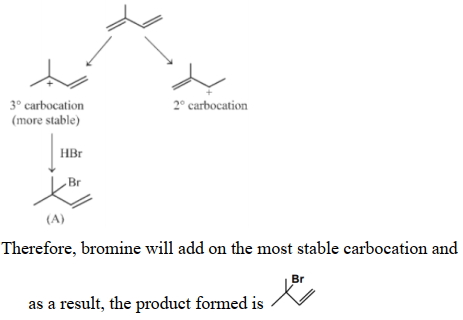
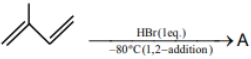
If $HBr$ attacks on left side double bond of the conjugated diene, then the formation of tertiary carbocation occur which is highly stable and if $HBr$ attacks on right side double bond, the formation of secondary carbocation occurs which is less stable.

Need a full question paper?

Generate a complete, print-ready paper with questions like this in minutes — across 16+ boards, with answer keys.

Start Generating Free

Similar questions

Match List $I$ with List $II$.

List $I$ Isomeric pairs List $II$ Type of isomers
$A$ Propanamine and $N-$Methylethanamine $I$ Metamers
$B$ Hexan$-2-$one and Hexan$-3-$one $II$ Positional isomers
$C$ Ethanamide and Hydroxyethanimine $III$ Functional isomers
$D$ $o-$nitrophenol and $p-$nitrophenol $IV$ Tautomers

Choose the correct answer from the options given below :-

$Pt|{H_2}\left( {1\,atm} \right)|{H^ + }\left( {0.001\,M} \right)||{H^ + }\left( {0.1\,M} \right)|{H_2}(1\,atm)|Pt$ What will be the value of $E_{cell}$ for this cell? ............. $\mathrm{V}$
Which of the following molecules acts as a Lewis acid ?
Which of the following graph is correct representation between atomic number $(Z)$ and magnetic moment of $d-block$ elements? [Outer electronic configuration : $(n -1)d^x\, ns^{1\, or \,2}$]
The major product of the following reaction is 

$Image$

Among the following series of transition metal ions, the one where all metals ions have $3{d^2}$ electronic configuration is
Given below are two statements:

Statement $I$: $\mathrm{PF}_5$ and $\mathrm{BrF}_5$ both exhibit $\mathrm{sp}^3 \mathrm{~d}$ hybridisation.

Statement $II$: Both $\mathrm{SF}_6$ and $\left[\mathrm{Co}\left(\mathrm{NH}_3\right)_6\right]^{3+}$ exhibit $\mathrm{sp}^3 \mathrm{~d}^2$ hybridisation.

In the light of the above statements, choose the correct answer from the options given below:

The reason for double helical structure of $DNA$ is operation of
Example of vinylic halide is
$0.16\, g$ of dibasic acid required $25 \,ml$ of decinormal $NaOH$ solution for complete neutralisation. The molecular weight of the acid will be