MCQ
$\,$
  • A


  • C

  • D

Answer

Correct option: B.

b

Need a full question paper?

Generate a complete, print-ready paper with questions like this in minutes — across 16+ boards, with answer keys.

Start Generating Free

Similar questions

Which factor is most responsible for the increase in boiling points of noble gases from $He$ to $Xe$?
Which of the following is not a characteristic of transition element
Which one of the following would lose weight on exposure to atmosphere
$\begin{matrix}
   O\,\,\,\,\,\,\,\,\,\,\,\,\,\,\,\, \\
   ||\,\,\,\,\,\,\,\,\,\,\,\,\,\,\,\,\,  \\
   H-C-D\xrightarrow{{{H}^{18}}{{O}^{-}}}  \\
\end{matrix}\begin{matrix}
   O\,\,\,\,\,\,\,\,\,\,\,\,\,\,\,\,\,\,\,\,\,\,\,\,\,\,\,\,\,\,\,\,\,\,\,\,\,\,\,\,\,\,\,\,\,\,\,  \\
   ||\,\,\,\,\,\,\,\,\,\,\,\,\,\,\,\,\,\,\,\,\,\,\,\,\,\,\,\,\,\,\,\,\,\,\,\,\,\,\,\,\,\,\,\,\,\,\,\,  \\
   D-C-{}^{18}{{O}^{-}}+C{{H}_{2}}D-OH  \\
\end{matrix}$

Above reaction is known as

The half-life of a first order reaction having rate constant $K = 1.7 \times 10^{-5}$ $s^{-1}$ is ........ $hr$
The $d-$ electron configurations of $cr^{2+}, Mn^{2+}, Fe^{2+}$ and $Co^{2+}$ are $d^4, d^5, d^6$ and $d^7$ respectively. Which one of the following will exhibit the lowest paramagnetic behaviour? (Atomic no.$Cr = 24,\,Mn = 25,\,Fe = 26,\,Co = 27$).
Silicon has a strong tendency to form polymers like silicones. The chain length of silicones polymer can be controlled by adding
Which one of the following objects is ‘achiral’
The value of $K _{ C }$ is $64$ at $800\, K$ for the reaction $N _{2}( g )+3 H _{2}( g ) \rightleftharpoons 2 NH _{3}( g )$

The value of $K _{ C }$ for the following reaction is :

$NH_{3}(g) \rightleftharpoons \frac{1}{2} N _{2}(g)+\frac{3}{2} H_{2}(g)$

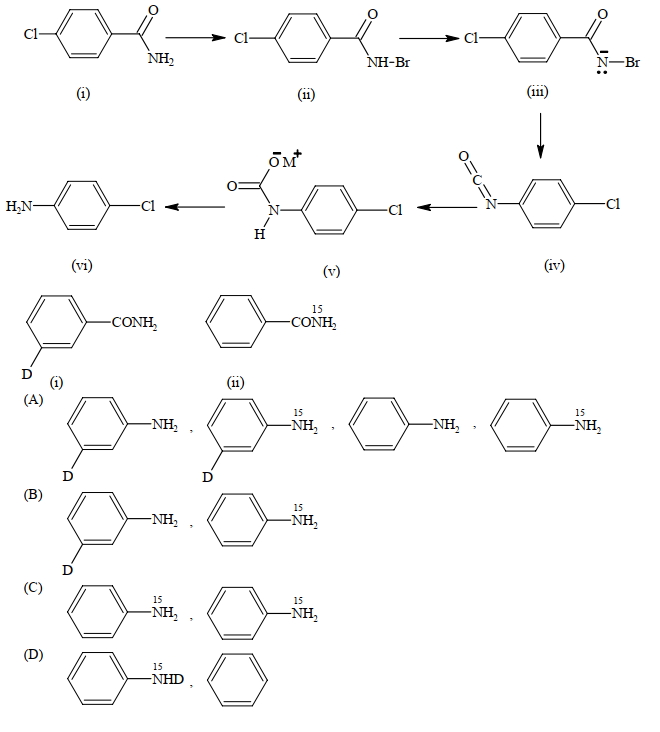
$\mathrm{RCONH}_2$ is converted into $\mathrm{RNH}_2$ by means of Hofmann bromamide degradation.

$Image$

In this reaction, $\mathrm{RCONHBr}$ is formed from which this reaction has derived its name. Electron donating group at phenyl activates the reaction. Hofmann degradation reaction is an intramolecular reaction.

$1.$  How can the conversion of $(i)$ to $(ii)$ be brought about?

$(A)$ $\mathrm{KBr}$  $(B)$ $\mathrm{KBr}+\mathrm{CH}_3 \mathrm{ONa}$  $(C)$ $\mathrm{KBr}+\mathrm{KOH}$  $(D)$ $\mathrm{Br}_2+\mathrm{KOH}$

$2.$  Which is the rate determining step in Hofmann bromamide degradation?

$(A)$ Formation of $(i)$  $(B)$ Formation of $(ii)$  $(C)$ Formation of $(iii)$  $(D)$ Formation of $(iv)$

$3.$  What are the constituent amines formed when the mixture of $(i)$ and $(ii)$ undergoes Hofmann bromamide degradation?

$Image$

give the answer question $1$, $2$, and $3.$