MCQ
$1\%$  solution of $Ca{(N{O_3})_2}$ has freezing point
  • A
    ${0\,^o}C$
  • Less than ${0\,^o}C$
  • C
    Greater than ${0\,^o}C$
  • D
    None of the above

Answer

Correct option: B.
Less than ${0\,^o}C$
b
(b)Freezing point is lowered on addition of solute in it..

Need a full question paper?

Generate a complete, print-ready paper with questions like this in minutes — across 16+ boards, with answer keys.
Start Generating Free

Similar questions

Which of the following compounds will not undergo Friedel Craft's reaction with benzene ?
Which of the following can show optical isomerism
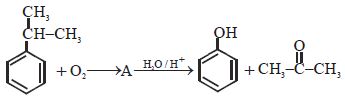
$A$ is
Given 

$C + 2S \to CS_2 ;  \,\Delta H_f^o = +117.0\,kJ\,mol^{-1} .......(1)$

$C + O_2 \to CO_2 ; \,\Delta H_f^o = -393\,kJ\,mol^{-1} .......(2)$

$S + O_2 \to SO_2 ; \, \Delta H_f^o = -297\,kJ\,mol^{-1} .......(3)$

The heat of reaction of

$CS_2 + 3O_2 \to CO_2 + 2SO_2$ is

.....$kJ\,mol^{-1}$

$Ph-CH(OH)CH_3 \xrightarrow{{SOC{l_2}}}$ major product 
For the reaction ${N_{2(g)}} + 3{H_{2(g)}}$ $\rightleftharpoons$ $2N{H_{3(g)}}$, the correct expression of equilibrium constant $K$ is
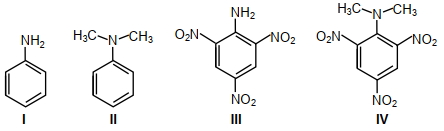
Consider the following four compounds $I, II, III,$ and $IV$.

Choose the correct statement($s$).

$(A)$ The order of basicity is $II > I > III > IV$ .

$(B)$ The magnitude of $p K_{ b }$ difference between $I$ and $II$ is more than that between $III$ and $IV$.

$(C)$ Resonance effect is more in $III$ than in $IV$.

$(D)$ Steric effect makes compound $IV$ more basic than $III$.
If the wavelength for an electron emitted from $H$ atom is $3.3 \times 10^{-10}\,m$, then energy absorbed by the electron in its ground state compared to minimum energy required for its escape from the atom, is $.......$times. (Nearest integer).

[Given $: h =6.626 \times 10^{-34}\,Js$,Mass of electron $=9.1 \times 10^{-31}$ ]

The cell reaction of a cell is $M{g_{(s)}} + C{u^{2 + }}(aq) \to C{u_{(s)}} + M{g^{2 + }}(aq)$ If the standard reduction potentials of $Mg$ and $Cu$ are $ - \,2.37$ and $ + \,0.34\,V$ respectively. The emf of the cell is ................. $\mathrm{V}$
Which of the following is not a characteristics of a covalent compound?