Question
$1V$ equals:

Answer

$1$ volt is equal to $1$ joule of electric potential energy per $($divided by$) 1$ coulomb of charge.
$V= J/ C =$ joule/ coulomb

Need a full question paper?

Generate a complete, print-ready paper with questions like this in minutes — across 16+ boards, with answer keys.
Start Generating Free

Similar questions

Two ions having masses in the ratio 1 : 1 and charges 1 : 2 are projected into uniform magnetic field perpendicular to the field with speeds in the ratio 2 : 3. The ratio of the radii of circular paths along which the two particles move is(a) 4 : 3(b) 2 : 3(c) 3 : 1(d) 1 : 4
       
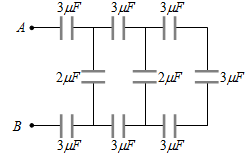
The resultant capacitance between $A$ and $B$ in the following figure is equal to
If a linear isotropic dielectric is placed in an electric field of strength E, then the polarization P is:
In an electroplating experiment, m gm of silver is deposited when 4 ampere of current flows for 2 minute. The amount (in gm) of silver deposited by 6 ampere of current for 40 second will be(a) 4 m(b) m/2 (c) m/4 (d) 2 m
       
Assertion  :   Sun is at the galactic centre C of the milky way
Reason      :  All planets of solar system revolve around the sun.(a) If both assertion and reason are true and the reason is the correct explanation of the assertion.(b) If both assertion and reason are true but reason is not the correct explanation of the assertion.(c) If assertion is true but reason is false.(d) If assertion is false but reason is true.


A solenoid has an inductance of $60$ henrys and a resistance of $30$ ohms. If it is connected to a $100$ volt battery, how long will it take for the current to reach $\frac{e{-1}}{e} \approx 63.2 \%$  of its final value
The distance between two points is 30 cm . If $20 \mu C$ charge is kept at point A and $-10 \mu C$ charge is kept at point B, then at which point between A and B the potential will be zero :
A thermocouple of resistance 1.6Ω is connected in series with a galvanometer of 8Ω resistance. The thermocouple develops and e.m.f. of 10 μV per degree temperature difference between two junctions. When one junction is kept at 0℃  and the other in a molten metal, the galvanometer reads 8 millivolt. The temperature of molten metal, when e.m.f. varies linearly with temperature difference, will be(a) 960℃ (b) 1050℃(c) 1275℃(d) 1545℃
       
A hot electric iron has a resistance of 80 Ω and is used on a 200 V source. The electrical energy spent, if it is used for two hours, will be(a) 8000 Wh(b) 2000 Wh(c) 1000 Wh(d) 800 Wh
       
Two metal spheres of capacitance $C_1$  and $C_2$ carry some charges. They are put in contact and then separated. The final charges $Q_1$ and  $Q_2$ on them will satisfy