Question
$2, 4-D$  is a

Answer

b
(b) $2, 4-D$  is a selective weedkiller. It is highly toxic to broad-leaved plants. It increases carbohydrate metabolism to such an extent that the plants burn themselves to death in dicots.

Need a full question paper?

Generate a complete, print-ready paper with questions like this in minutes — across 16+ boards, with answer keys.

Start Generating Free

Similar questions

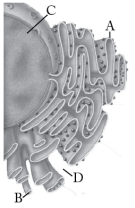
Identify the components labelled $A, B, C$ and $D$ in the diagram below from the list $(i)$ to $(viii)$ given along with

Components:

$(i)$ Cristae of mitochondria

$(ii)$ Inner membrane of mitochondria

$(iii)$ Cytoplasm

$(iv)$ Smooth endoplasmic reticulum

$(v)$ Rough endoplasmic reticulum

$(vi)$ Mitochondrial matrix

$(vii)$ Cell vacuole

$(viii)$ NucleusThe correct components are:
A chromosome in which the $centromere$ is situated near one end is known as
When, during the meiotic division, do the centromeres divide
$A$ : Thallophytes are non-vascular, non-archegoniate and non-cormophytic plants.
$R$ : Thallophytes lack vascular bundles, archegonia and differentiated plant body.
The oxygen liberated during the photosynthesis comes from
Choose correct sentences :

$(1)$ The meristem which present at the tips of roots and shoots are called apical meristem

$(2)$ Apical meristem are secondary meristem

$(3)$ Intercalary meristem is the meristem that occurs in the mature region of roots and shoots of many plants and appear later than primary meristem :

$(4)$ Fascicular vascular cambium and interfascicular cambium are lateral meristem

In some children $ADA$ deficiency can be cured by
Some times the change in allele frequency is so different in the new sample of population that they become a different species the original drifted population becomes founders and the effect is called
Which of the following are homosporous
The gibberellins are plant growth hormones. They cause elongation of stems. Gibberellin was first isolated by Japanese workers from