MCQ
$2.0\,molar$ solution is obtained , when $ 0.5\,mole$ solute is dissolved in
  • A
    $250\,ml$ solvent
  • B
    $250\,g$ solvent
  • $250\,ml$ solution
  • D
    $1000\,ml$ solvent

Answer

Correct option: C.
$250\,ml$ solution
c
(c) We know that

Molarity $ = \frac{{{\rm{Number\,of \, moles\,  of \, solute}}}}{{{\rm{Volume\,of\, solution\, in }}litre}}$

$\therefore 2.0 = \frac{{0.5}}{{{\rm{Volume\,  of\,  solution\,  in}}\,\,litre}}$

Volume of solution in litre $ = \frac{{0.5}}{{2.0}} = 0.250\,litre = 250\,ml.$

Need a full question paper?

Generate a complete, print-ready paper with questions like this in minutes — across 16+ boards, with answer keys.

Start Generating Free

Similar questions

Vant hoff factor of $BaC{l_2}$ of conc. $0.01\,M$ is $1.98. $ Percentage dissociation of $BaC{l_2}$ on this conc. Will be
$[Co(NH_3)_4(NO_2)_2]Cl$ exhibits
Fittig's reaction produces
During adsorption the $\Delta H$ is $-ve$ and the magnitude of $-ve$ value
Treatment of $D$ - glucose with aqueous $NaOH$ results in a mixture of monosaccharides, which are
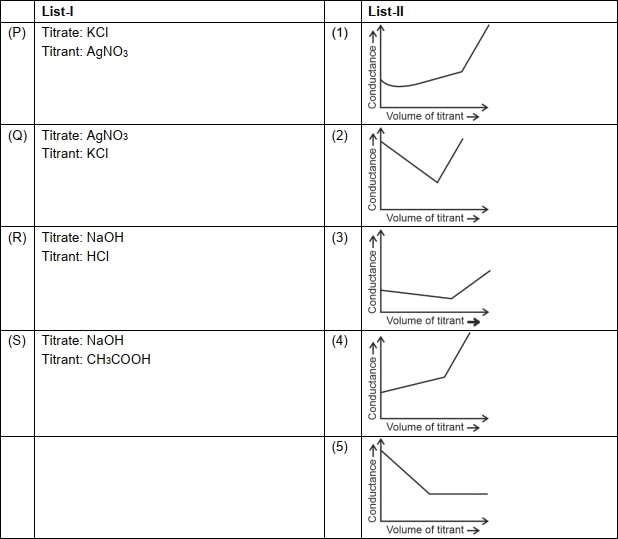
In a conductometric titration, small volume of titrant of higher concentration is added stepwise to a larger volume of titrate of much lower concentration, and the conductance is measured after each addition.

The limiting ionic conductivity ( $\Lambda 0$ ) values (in $mS m ^2 mol ^{-1}$ ) for different ions in aqueous solutions are given below:

Ions $Ag ^{+}$ $K ^{+}$ $Na ^{+}$ $H ^{+}$ $NO _3^{-}$ $CI ^{-}$ $SO _4^{2-}$ $OH ^{-}$ $CH_3COO ^{-}$
$\Lambda_0$ $6.2$ $7.4$ $5.0$ $35.0$ $7.2$ $7.6$ $16.0$ $19.9$ $4.1$

For different combinations of titrates and titrants given in $List-l$, the graphs of 'conductance' versus 'volume of titrant' are given in $List-II$.

Match each entry in $List-I$ with the appropriate entry in $List-II$ and choose the correct option.
Which of the following solutions has the highest normality
Evaluate the following statements related to group 14 elements for their correctness.
(A) Covalent radius decreases down the group from C to Pb in a regular manner.
(B) Electronegativity decreases from C to Pb down the group gradually.
(C) Maximum covalence of C is 4 whereas other elements can expand their covalence due to presence of d orbitals.
(D) Heavier elements do not form $p \pi$-p $\pi$ bonds.
(E) Carbon can exhibit negative oxidation states. Choose the correct answer from the options given below:
Which of the following melts in boiling water
For the precipitation reaction of $A{g^ \oplus }$ ions with $NaCl,$ which of the following statements is true ?