MCQ
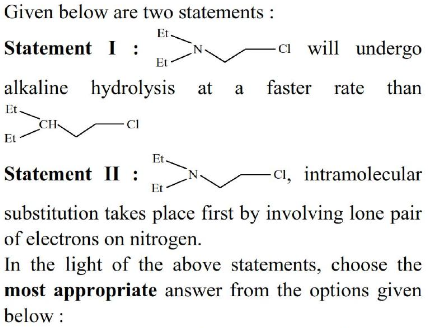
Image
  • A
    Both Statement I and Statement II are incorrect
  • B
    Statement I is incorrect but statement II is correct
  • C
    Both Statement I and Statement II are correct
  • D
    Statement I is correct but Statement II is incorrect

Answer

Need a full question paper?

Generate a complete, print-ready paper with questions like this in minutes — across 16+ boards, with answer keys.

Start Generating Free

Similar questions

The number of oxygens present in a nucleotide formed from a base, that is present only in $RNA$ is ....
The standard electrode potential of $M ^{+} / M$ in aqueous solution does not depend on
In the following reaction${P_4} + 3NaOH + 3{H_2}O \to P{H_3} + 3Na{H_2}P{O_2}$
The number of possible alcoholic isomers for ${C_4}{H_{10}}O$ are
For the given hypothetical reactions, the equilibrium constants are as follows: $X \rightleftharpoons Y ; K_1=1.0 , Y \rightleftharpoons Z ; K_2=2.0 , Z \rightleftharpoons W ; K_3=4.0$ The equilibrium constant for the reaction $X \rightleftharpoons W$ is
The rate of a reaction decreased by $3.555$ times when the temperature was changed from $40^{\circ} C$ to $30^{\circ} C$. The activation energy of the reaction is.........$kJ\, mol ^{-1}$

[Take; $R =8.314 \,J\, mol ^{-1}\, K ^{-1}$ In $3.555=1.268$]
$20\,mL$ of $0.02\,M\,K _{2} Cr _{2} O _{7}$ solution is used for the titration of $10 \,mL$ of $Fe ^{2+}$ solution in the acidic medium.The molarity of $Fe ^{2+}$ solution is ........... $\times 10^{-2}\,M$ (Nearest Integer)
$\,$
In the reaction ${B_2}{O_3} + C + C{l_2} \to A + CO.$ The $A$ is
The following data is given for reaction between $A$ and $B$

$S.NO.$  $[A]$    $mol.L^{-1}$  $[B]$    $mol.L^{-1}$ $Rate$    $mol.L^{-1}\,sec^{-1}$
$I$ $1 \times 10^{-2}$ $2 \times 10^{-2}$ $2 \times 10^{-4}$
$II$ $2 \times 10^{-2}$ $2 \times 10^{-2}$ $4 \times 10^{-4}$
$III$ $2 \times 10^{-2}$ $4 \times 10^{-2}$ $8 \times 10^{-4}$ 

  Which of the following are correct statements -

$(a)$  Rate constant of the reaction $10^{-4}$

$(b)$  Rate law of the reaction is $k[A][B]$

$(c)$  Rate of reaction increases four times on doubling the concentration of both the reactant