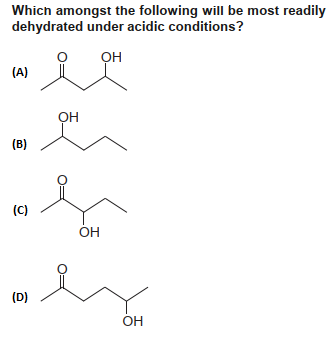
Question
Image

Answer

(A)
Image
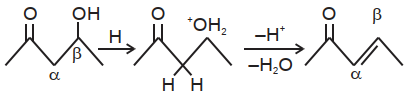
$\beta$-hydroxy ketone readily undergo dehydration to form $\alpha, \beta$ unsaturated ketones.

Need a full question paper?

Generate a complete, print-ready paper with questions like this in minutes — across 16+ boards, with answer keys.

Start Generating Free

Similar questions

When an organic compound was treated with sodium nitrite and hydrochloric acid in the ice cold, nitrogen gas was evolved copiously. The compound is
The outer most shell electronic configuration of transition element is
During the kinetic study of the reaction, $2A + B \rightarrow C + D,$ following results were obtained

Run $[A]/mol\,L^{-1}$ $[B]/mol\,L^{-1}$ Initial rate of formation of $D/mol\,L^{-1}\,min^{-1}$
$I.$ $0.1$ $0.1$ $6.0 \times 10^{-3}$
$II.$ $0.3$ $0.2$ $7.2 \times 10^{-2}$
$III.$ $0.3$ $0.4$ $2.88 \times 10^{-1}$
$IV.$ $0.4$ $0.1$ $2.40 \times 10^{-2}$

Based on the above data which one of the following is correct?

The element $Z= 114$ has been discovered recently. It will belong to which of the following family/group and electronic configuration?
If salt $Q$ undergoes redox reaction with $H_2S$ in acidic medium then which of the following species can not be possible product?
Electrolysis of dilute aqueous $\mathrm{NaCl}$ solution was carried out by passing $10$ milli ampere current. The time required to liberate $0.01 \mathrm{~mol}$ of $\mathrm{H}_2$ gas at the cathode is ( $1$ Faraday $=96500 \mathrm{C} \mathrm{mol}^{-1}$ )
Which of the following hydrides has the lowest boiling point
$A + {H_2}O \to B + HCl$

$B + {H_2}O \to C + HCl$

Compound $(A),\,(B)$ and $(C)$ will be respectively

$2-$ hexene $\longrightarrow$ Products

The two products formed in above reaction are -

What will be de-Broglie wavelength of an electron moving with a velocity of $1.2 \times {10^5}\,m{s^{ - 1}}$