MCQ

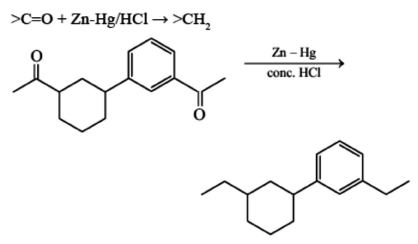
- Adil. NaOH
- ✓$Zn - Hg + HCl$
- C[O]
- DNaOCl
Generate a complete, print-ready paper with questions like this in minutes — across 16+ boards, with answer keys.
$(I) \,C{H_3}CH = C{H_2} + HBr\xrightarrow{{peroxide}}$
$(II)\, C{H_3}CH = C{H_2} + HBr\xrightarrow{{CC{l_4}}}$
$(III)\, C{H_3}C{H_2}C{H_3} + B{r_2}\xrightarrow{{hv}}$
$(IV)\,C{H_3}CH = C{H_2} + B{r_2}\xrightarrow{{CC{l_4}}}$
Assertion $A$ :Magnesium can reduce $Al _{2} O _{3}$ at a temperature below $1350^{\circ} C$, while above $1350^{\circ} C$ aluminium can reduce $MgO$.
Reason $R$ : The melting and boiling points of magnesium are lower than those of aluminium.
In light of the above statements. choose most appropriate answer from the options given below
$(I)$ Cis $-[Co(NH_3)_2(en)_2]^{+3}$
$(II)$ Trans $-[Ir \,Cl_2\, (C_2O_4)_2]^{-3}$
$(III)$ $[Rh(en)_3]^{+3}$
$(IV)$ Cis $-[Ir(H_2O)_3Cl_3]$