MCQ
$2CuI\, \to Cu + Cu{I_2}$, the reaction is
  • Redox
  • B
    Neutralisation
  • C
    Oxidation
  • D
    Reduction

Answer

Correct option: A.
Redox
(a) $\mathop {2CuI}\limits^{ + 1\,\,} \to \mathop {Cu}\limits^0 \,\, + \mathop {Cu{I_2}}\limits^{ + 2\,\,\,\,\,} $. Oxidation and Reduction both occur so the reaction is redox.

Need a full question paper?

Generate a complete, print-ready paper with questions like this in minutes — across 16+ boards, with answer keys.

Start Generating Free

Similar questions

Which of the following is non-polar
Olefins can be hydrogenated by
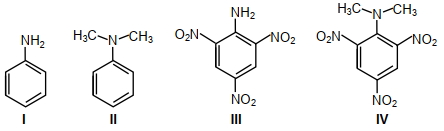
Consider the following four compounds $I, II, III,$ and $IV$.

Choose the correct statement($s$).

$(A)$ The order of basicity is $II > I > III > IV$ .

$(B)$ The magnitude of $p K_{ b }$ difference between $I$ and $II$ is more than that between $III$ and $IV$.

$(C)$ Resonance effect is more in $III$ than in $IV$.

$(D)$ Steric effect makes compound $IV$ more basic than $III$.
${{(EtO)}_{2}}CHCHO+C{{H}_{3}}MgI\xrightarrow{{{H}_{3}}{{O}^{\oplus }}}(A)$

Product obtained in the above reaction is

Amongst the following electrodes the one with zero electrode potential is
Carbohydrates are stored in human body as
$\mathop {Ph - MgBr}\limits^{{\text{[Excess]}}}       + $ $\begin{array}{*{20}{c}}
  {O\,\,\,\,} \\ 
  {||\,\,\,\,} \\ 
  {Cl - C - C{H_3}} 
\end{array}$ $\xrightarrow{{2{H^ \oplus }}}$ 

Final proudct of above reaction

Given below are two statements : one is labelled as Assertion $A$ and the other is labelled as Reason $R:$

Assertion $A:$ Metallic sodium dissolves in liquid ammonia giving a deep blue solution, which is paramagnetic.

Reason $R:$ The deep blue solution is due to the formation of amide.

In the light of the above statements, choose the correct answer from the options given below :
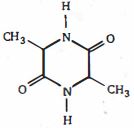
The number of stereoisomers formed by the given compound is
What is the molar solubility of $Al(OH)_3$ in $0.2\, M\, NaOH$ solution? Given that, solubility product of $Al(OH)_3 = 2.4 \times 10^{-24}$