MCQ
$2{\sin ^{ - 1}}\frac{3}{5} + {\cos ^{ - 1}}\frac{{24}}{{25}} = $
  • $\frac{\pi }{2}$
  • B
    $\frac{{2\pi }}{3}$
  • C
    $\frac{{5\pi }}{3}$
  • D
    None of these

Answer

Correct option: A.
$\frac{\pi }{2}$
a
(a) $2\,{\sin ^{ - 1}}\frac{3}{5} + {\cos ^{ - 1}}\frac{{24}}{{25}} = {\sin ^{ - 1}}2 \times \frac{3}{5}\sqrt {1 - \frac{9}{{25}}} + {\cos ^{ - 1}}\frac{{24}}{{25}}$

$ = {\sin ^{ - 1}}\frac{{24}}{{25}} + {\cos ^{ - 1}}\frac{{24}}{{25}} = \frac{\pi }{2}$.

Need a full question paper?

Generate a complete, print-ready paper with questions like this in minutes — across 16+ boards, with answer keys.
Start Generating Free

Similar questions

If $x = cy + bz,\,\,y = az + cx,\,\,z = bx + ay$ (where $x, y, z $ are not all zero) have a solution other than $x = 0$, $y = 0$, $z = 0$ then $a, b$  and $ c $ are connected by the relation
To write the dual; it should be ensured that
  1.  All the primal variables are non - negative.
  2. All the bi values are non - negative.
  3. All the constraints are $\leq$ type if it is maximization problem and $\geq$ type if it is a minimization problem.
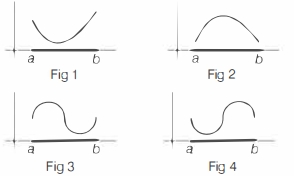
The following figure shows the graph of a differentiable function $y=f(x)$ on the interval $[a, b]$ (not containing $0$ ).  $FIGURE$  Let $g(x)=\frac{f(x)}{x}$. Which of the following is a possible graph of $y=g(x) ?$
Direction ratio of line joining (2, 3, 4) and (-1, -2, 1), are:
  1. (-3, -5, -3)
  2. (-3, 1, -3)
  3. (-1, -5, -3)
  4. (-3, -5, 5)
If ${ \sin }^{ -1 }\frac { \text{x} }{ 5 } +{ \text{cosec} }^{ -1 }\frac { 5 }{ 4 } $ then x is equal to:
  1. 1
  2. 4
  3. 3
  4. 5
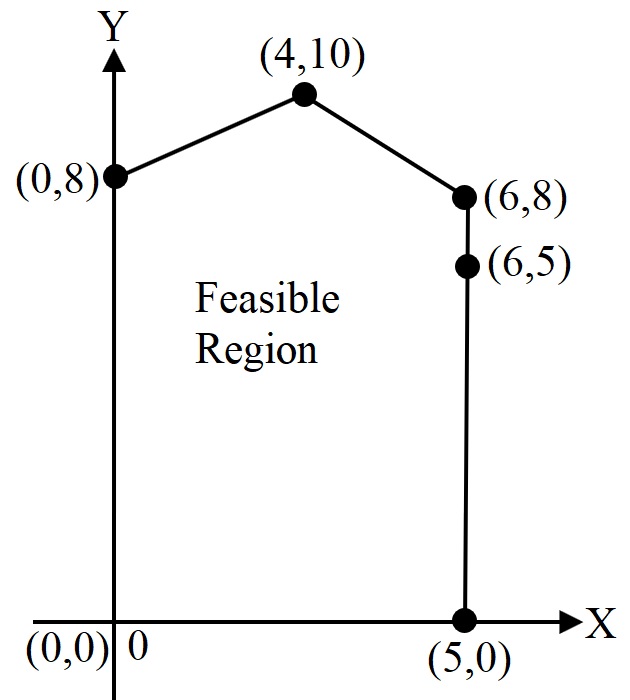
The feasible region for a LPP is shown shaded in the figure. Let Z = 3x - 4y be the objective function. Minimum of Z occurs at.

  1. (0, 0)
  2. (0, 8)
  3. (5, 0)
  4. (4, 10)
If $\vec a\, = \,\vec i - 2\hat j + 3\hat k,\,\,\,\vec b = 2\vec i + 3\hat j - \hat k$ and $\vec c = \lambda \vec i + \hat j + (2\lambda  - 1\hat k)$ are coplanar vectors, then $\lambda $ is equal to
Let $ y $ be an implicit function of  $x$ defined by ${x^{2x}} - 2{x^x}\cot y - 1 = 0$ .Then  $y'\left( 1 \right)$ equals
Let X be a discrete random variable. Then the variance of X is:

  1. E(X2)

  2. E(X2) + (E(X))2

  3. E(X2) - (E(X))2

  4. $\sqrt{\text{E}(\text{X}^2)-(\text{E}(\text{X}))^2}$

The domain of the function defined by $f(x)=\sin ^{-1} \sqrt{x-1}$ is