MCQ
$2{\tan ^{ - 1}}\frac{1}{3} + {\tan ^{ - 1}}\frac{1}{2} = $
  • A
    ${90^o}$
  • B
    ${60^o}$
  • C
    ${45^o}$
  • ${\tan ^{ - 1}}2$

Answer

Correct option: D.
${\tan ^{ - 1}}2$
d
(d) $2\,{\tan ^{ - 1}}\frac{1}{3} + {\tan ^{ - 1}}\frac{1}{2} = {\tan ^{ - 1}}\left( {\frac{{\frac{2}{3}}}{{1 - \frac{1}{9}}}} \right) + {\tan ^{ - 1}}\left( {\frac{1}{2}} \right)$
$ = {\tan ^{ - 1}}\left( {\frac{{\frac{2}{3}}}{{\frac{8}{9}}}} \right) + {\tan ^{ - 1}}\left( {\frac{1}{2}} \right) = {\tan ^{ - 1}}\,\left( {\frac{3}{4}} \right) + {\tan ^{ - 1}}\left( {\frac{1}{2}} \right)$
$ = {\tan ^{ - 1}}\left( {\frac{{\frac{1}{2} + \frac{3}{4}}}{{1 - \frac{1}{2} \times \frac{3}{4}}}} \right) = {\tan ^{ - 1}}(2)$.

Need a full question paper?

Generate a complete, print-ready paper with questions like this in minutes — across 16+ boards, with answer keys.

Start Generating Free

Similar questions

Choose the correct answer from the given four options.
If A and B are two independent events with $\text{P}(\text{A})=\frac{3}{5}$ and $\text{P}(\text{A})=\frac{4}{9},$ then $\text{P}(\text{A'}\cap\text{B'})$ equals:
Let $A = \left( {\begin{array}{*{20}{c}}1&{ - 1}&1\\2&1&{ - 3}\\1&1&1\end{array}} \right)$ and $(10)B = \left( {\begin{array}{*{20}{c}}4&2&2\\{ - 5}&0&\alpha \\1&{ - 2}&3\end{array}} \right)$. If $B$ is the inverse of matrix $A$, then $\alpha $ is
If $f(x)=\left\{\begin{array}{l}x, \text { if } x \leq 1 \\ 7, \text { if } x>1\end{array}\right.$, then
The law a + b = b + a is called:
  1. Closure law.
  2. Associative law.
  3. Commutative law.
  4. Distributive law.
$\int\limits_a^b {} \, [x] \,dx + \int\limits_a^b {} \, [ - x] \,dx$

where $[. ]$ denotes greatest integer function is equal to :
Let $f(x)=x^2$ and $g(x)=\sin x$ for all $x \in R$. Then the set of all $x$ satisfying $(f \circ g \circ g \circ f)(x)=(g \circ g \circ f)(x)$, where $(f \circ g)(x)=f(g(x))$, is
Suppose that $F (x) $ is an antiderivative of $f (x) $ =$\frac{{\sin x}}{x}$ , $x > 0$  then $\int\limits_1^3 {\frac{{\sin 2x}}{x}dx} $ can be expressed as
Bag $A$ contains $4$ green and $3$ red balls and bag $B$ contains $4$ red and $3$ green balls. One bag is taken at random and a ball is drawn and noted it is green. The probability that it comes bag $B$
Let $f(x) ={\left( {{x^x}} \right)^x}$ and $g(x) ={x^{\left( {{x^x}} \right)}}$ then :
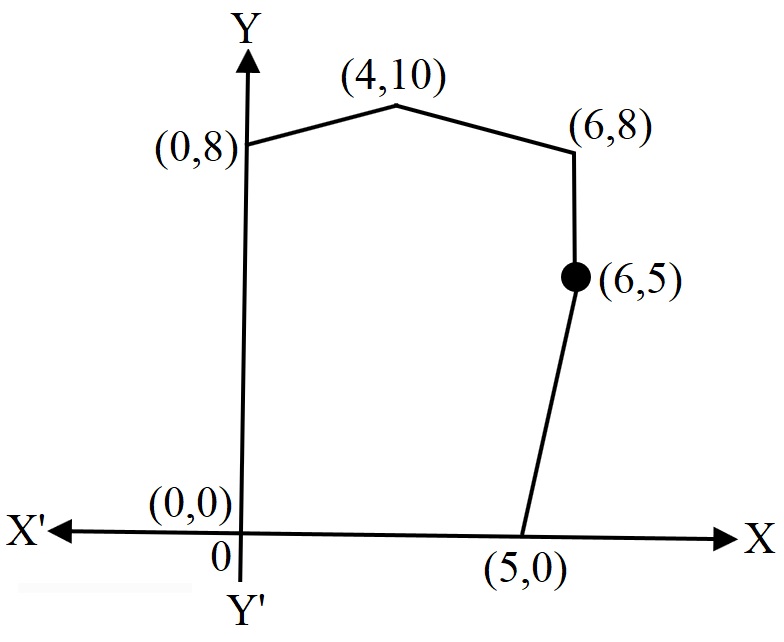
The feasible solution for a LPP is shown in the following figure. Let Z = 3x - 4y be the objective function.

Minimum of Z occurs at:

  1. (0, 0)
  2. (0, 8)
  3. (5, 0)
  4. (4, 10)