MCQ
30 mg is the same mass as:
  • A
    0.0003 kg
  • 0.03 g
  • C
    300 decigrams
  • D
    0.3 grams

Answer

Correct option: B.
0.03 g
(b) 0.03 g
Explanation: since $1000 mg =1 g$
$
\begin{aligned}
& \therefore 30 mg \\
& =[(1 / 1000) \times 30] g \\
& =0.03 g
\end{aligned}
$

Need a full question paper?

Generate a complete, print-ready paper with questions like this in minutes — across 16+ boards, with answer keys.

Start Generating Free

Similar questions

Which of the following is the incorrect match for atom of element ?
In Dumas' method of estimation of nitrogen $0.35\, g$ of an organic compound gave $55\, mL$ of nitrogen collected at $300\, K$ temperature and $715\, mm$ pressure. The percentage composition of nitrogen in the compound would be (aqueous tension at $300\, K = 15\, mm$).
Which of the following has acidic hydrogen
For the reaction $PC{l_5}_{(g)}$ $\rightleftharpoons$ $PC{l_3}_{(g)} + C{l_2}_{(g)}$
Out of the following, the alkene that exhibits optical isomerism is
$C_4H_6O_2$ does not represent :
A compound contains atoms of three elements in $A, B$ and $C$. If the oxidation number of $A$ is $+2, B$ is $+5$ and that of $C$ is $-2$, the possible formula of the compound is
વિધાન : Ozone is powerful oxidising agent in comparison to $O_2$.
કારણ : Ozone is diamagnetic but $O_2$ is paramagnetic.
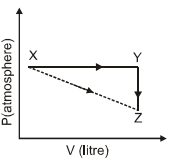
For an ideal gas, consider only $P - V$ work in going from an initial state $X$ to the final stat $Z$. The final state $Z$ can be reached by either of the two paths shown in the figure. Which of the following choice$(s)$ is (are) correct? [take $\Delta S$ as change in entropy and w as work done].

$(A)$ $\Delta S _{ x \rightarrow z}=\Delta S _{ x \rightarrow y}+\Delta S _{ y \rightarrow z}$

$(B)$ $w_{x \rightarrow z}=w_{x \rightarrow y}+w_{y \rightarrow z}$

$(C)$ $w_{x \rightarrow z \rightarrow z}=w_{x \rightarrow y}$

$(D)$ $\Delta S _{x \rightarrow y \rightarrow z}=\Delta S _{x \rightarrow y}$
Diagonal relationship is shown by: