Question
Generate a complete, print-ready paper with questions like this in minutes — across 16+ boards, with answer keys.
| Column I | Column II |
| (i) Neanderthal man | (a) Vestigial organ |
| (ii) Adaptive characters | (b) Darwin's theory |
| (iii) Natural selection | (c) 600 cc |
| (iv) Pinna | (d) 1400 cc |
| (e) Characters acquired during lifetime |
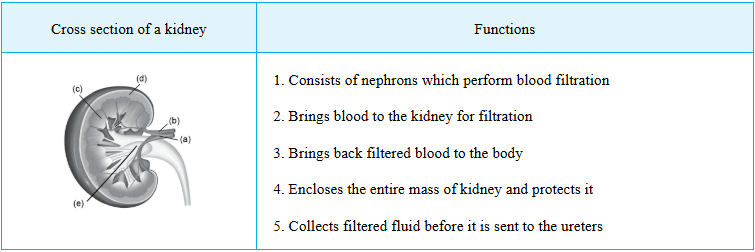
| Column I | Column II |
| (i) Nephrons | (a) The organ that collects filtrate and urine from renal pelvis and takes it to the bladder for urination. |
| (ii) Ureter | (b) The artery that brings waste-filled blood from the aorta to the kidney. |
| (iii) Renal artery | (c) |
| (iv) Glomerulus | (d) Filtration units in the kidneys. |
| (e) A cluster of blood capillaries surrounded by a bowman's capsule. |
| Column I | Column II |
| (i) Offspring | (a) Law of segregation |
| (ii) Phenotype | (b) External appearance |
| (iii) Purity of gametes | (c) Progeny produced due to reproduction |
| (iv) Unit factor | (d) Only one character |
| (e) Gene |
| I | II |
| (i) Karyokinesis | (a) Resting phase |
| (ii) Mitosis | (b) Reductional division |
| (iii) Interphase | (c) Division of cytoplasm |
| (iv) Cytokinesis | (d) Division of nucleus |
| (e) Somatic cell division |
| Column I | Column II |
| A. Turgid | (i) intake of mineral salts |
| B. Diffusion | (ii) a cell charged with water |
| C. Active transport | (iii) limiting membrane of a vacuole |
| D. Osmosis | (iv) movement of particles from higher to lower concentration |
| (v) movement of solvent across semi-permeable membrane |
| Column I | Column II |
| (i) Adrenal | (a) Master of master gland. |
| (ii) Hypothalamus | (b) Heterocrine gland. |
| (iii) Pancreas | (c) Increases heart and breathing rate, raises blood pressure. |
| (iv) Testes | (d) Emergency hormone. |
| (e) Produces male sex characteristics. |
| Column A | Column B |
| 1. Diffusion | (a) Xylem |
| 2. Semipermeable | (b) Osmosis |
| 3. Diffusion of water | (c) Mixing of molecules |
| 4. Upward flow of water | (d) Cell membrane |
| (e) Cell wall |
| Column I | Column II |
| (i) Glomerulus | (a) The triangle-shaped, hollow organ that collects urine. |
| (ii) Nephrology | (b) The outer region of the kidney. |
| (iii) Bladder | (c) The study of normal kidney function and kidney problems. |
| (iv) Renal cortex | (d) Filtration units in the kidneys. |
| (e) A cluster of blood capillaries surrounded by a bowman's capsule. |
| Column-I | Column-II |
| (A) Thrombokinase | (i) blood coagulation |
| (B) Lymphocytes | (ii) antitoxins |
| (C) Fibrinogen | (iii) calcium ions |
| (D) Antibodies | (iv) RBC |
| (v) antibodies |
| Column I | Column II |
| (i) Diffusion | (a) The pressure by which water rises upto some feet in a lofty tree. |
| (ii) Xylem | (b) Two solutions which have equal osmotic pressure. |
| (iii) Root pressure | (c) The tissue through which water and mineral salts move upward in a plant. |
| (iv) Isotonic solution | (d) The process by which roots absorb water from the soil. |
| (e) The process by which the molecules of perfume spread in the room when the bottle is open. |