Question
Generate a complete, print-ready paper with questions like this in minutes — across 16+ boards, with answer keys.
| Column I | Column II |
| A. Turgid | (i) intake of mineral salts |
| B. Diffusion | (ii) a cell charged with water |
| C. Active transport | (iii) limiting membrane of a vacuole |
| D. Osmosis | (iv) movement of particles from higher to lower concentration |
| (v) movement of solvent across semi-permeable membrane |
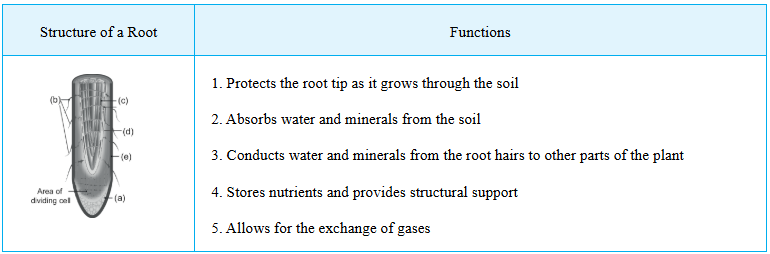
| Column I | Column II |
| (i) Cytokinins | (a) Acts as an anti-transpirant |
| (ii) 2, 4-D and 2,4,5-T | (b) Gibbane ring structure |
| (iii) Ethylene | (c) Used in tissue culture |
| (iv) Abscisic acid | (d) Eradication of weeds |
| (e) Promotes transverse growth |
| Column I | Column II |
| (i) Family Planning | (a) Counting of population |
| (ii) Vasectomy | (b) Sterilisation in females |
| (iii) Tubectomy | (c) Sterilisation in males |
| (iv) Census | (d) Red triangle |
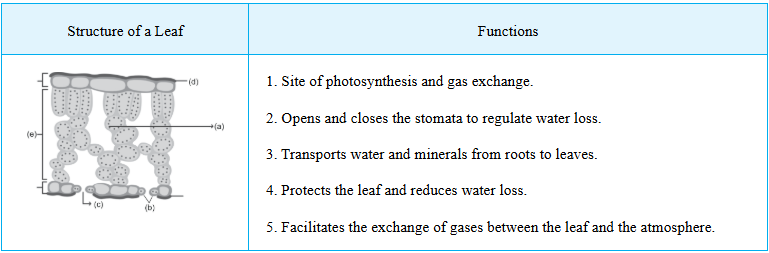
| Column I | Column II |
| (i) Grana | (a) Producers |
| (ii) Autotrophs | (b) Decomposers |
| (iii) By-products of photosynthesis | (c) Work rooms |
| (iv) Bacteria and fungi | (d) Glucose + oxygen |
| (e) Light reaction |
| Column I | Column II |
| (i) Pituitary | (a) Increases rate of metabolism. |
| (ii) Ovaries | (b) Development of a normal, healthy immune system. |
| (iii) Thyroid | (c) Heterocrine gland |
| (iv) Thymus | (d) Produces female sex characteristics. |
| (e) Simulates skeletal growth. |
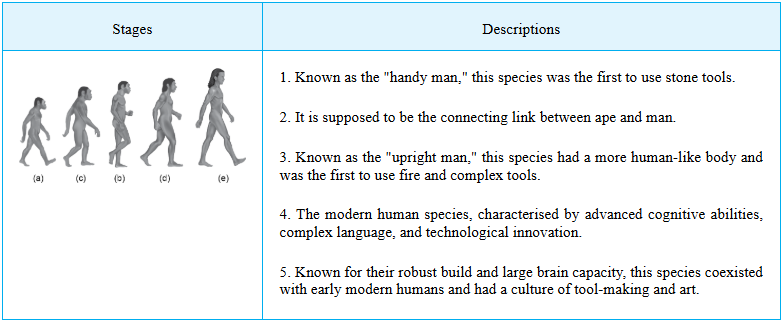
| Column I | Column II |
| (i) Australopithecus | (a) 735 cc |
| (ii) Homo habilis | (b) 900 cc |
| (iii) Homo erectus | (c) 850-1300 cc |
| (iv) Peking man | (d) 600 cc |
| (e) Vestigial organ |
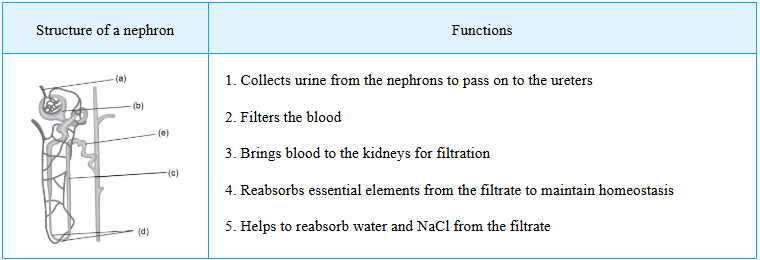
| Column I | Column II |
| (i) Glomerulus | (a) The triangle-shaped, hollow organ that collects urine. |
| (ii) Nephrology | (b) The outer region of the kidney. |
| (iii) Bladder | (c) The study of normal kidney function and kidney problems. |
| (iv) Renal cortex | (d) Filtration units in the kidneys. |
| (e) A cluster of blood capillaries surrounded by a bowman's capsule. |