
Question
Image

Answer

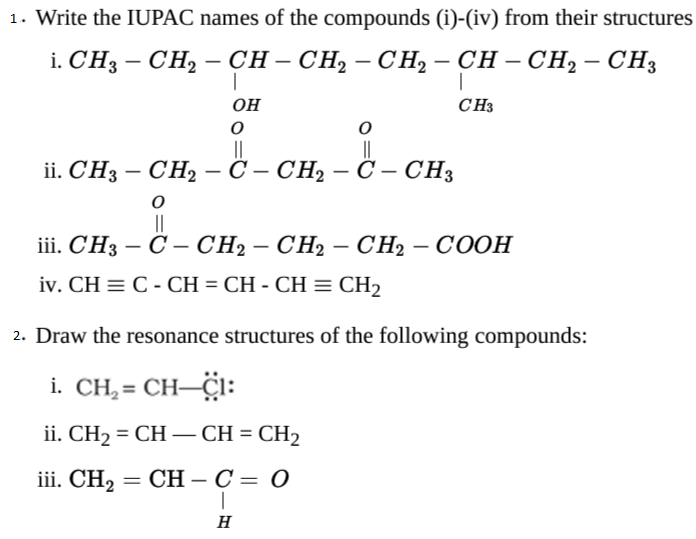
1. i. 6-methyl octan-3-ol,
ii. Hexane-2,4-dione,
iii. 5-oxohexanoic acid,
iv. Hexa-1, 3-dien-5-yne
2. Resonance structure of the given compounds are as follows:

Need a full question paper?

Generate a complete, print-ready paper with questions like this in minutes — across 16+ boards, with answer keys.

Start Generating Free

Similar questions

What is hyperconjugation? Explain with example and with help of this explain the stability of carbocations and alkenes.
Give general characters of elements of s, p, d and f-block.
A photon of wavelength 4 × 10 – 7m strikes on metal surface, the work function of the metal being 2.13eV. Calculate
  1. The energy of the photon (eV),
  2. The kinetic energy of the emission,
  3. The velocity of the photoelectron (1 eV = 1.6020 × 10 – 19J).
Explain why alkyl groups act as electron donors when attached to a $\pi$ system.
Why was a change in the Bohr Model of atom required? Due to which important development (s), concept of movement of an electron in an orbit was replaced by, the concept of probability of finding electron in an orbital? What is the name given to the changed model of atom?
Describe hybridisation in the case of PCl5 and SF6. The axial bonds are longer as compared to equatorial bonds in PCl5 whereas in SF6 both axial bonds and equatorial bonds have the same bond length. Explain.
The ionization constant of propanoic acid is 1.32 × 10⁻⁵. Calculate the degree of ionization of the acid in its 0.05M solution and also its pH. What will be its degree of ionization if the solution is 0.01M in HCl also?
Calculate the pH of 0.4g of NaOH dissolved in water to give 200ml of solution.
S. No
Column I
Column II
1.
[Mn(CO)5]-
+6
2.
[Mn2(CO)10]
+2
3.
K4[Mn(CN)6]
0
4.
K2MnO4
-1
What is the minimum volume of water required to dissolve 1g of calcium sulphate at 298K? (For calcium sulphate, Ksp is 9.1 × 10⁻⁶).