MCQ
$4200\, J$ of work is required for
  • A
    Increasing the temperature of $10\, gm$ of water through $10°C$
  • Increasing the temperature of $100\, gm$ of water through $10°C$
  • C
    Increasing the temperature of $1 \,kg$ of water through $10°C$
  • D
    Increasing the temperature of $10\, kg$ of water through $10°C$
Answer

Correct option: B.
Increasing the temperature of $100\, gm$ of water through $10°C$
b
(b) Work done to raise the temperature of $100\,gm$ water through $10°C$ is

$W = JQ = 4.2 \times (100 \times {10^{ - 3}} \times 1000 \times 10) = 4200\,J$

Need a full question paper?

Generate a complete, print-ready paper with questions like this in minutes — across 16+ boards, with answer keys.

Start Generating Free

Similar questions

A stone is projected with a velocity $20 \sqrt{2}\,m / s$ at an angle of $45^{\circ}$ to the horizontal. The average velocity of stone during its motion from starting point to its maximum height is $..........\,m/s$ (take $g=10\,m / s ^2$ )
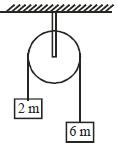
If the system is released, then the acceleration of the centre of mass of the system is
$A$ parallel coherent beam of light falls on fresnel biprism of refractive index $\mu$ and angle $\alpha$ . The fringe width on a screen at a distance $D$ from biprism will be (wavelength $= \lambda $)
In the following reaction, product $P$ is $R - \mathop {\mathop {C - }\limits^{||\,\,\,\,} }\limits^{O\,\,\,} Cl$  $\mathop {\xrightarrow{{{H_2}}}}\limits_{Pd - BaS{O_4}} P$
This question contains Statement$-1$ and statement$-2$. Of the four choices given after the statements, choose the one that best describes the two statements.
Statement$-1$: Energy is released when heavy nuclei undergo fission or light nuclei undergo fusion and
Statement$-2$ : For heavy nuclei, binding energy per nucleon increases with increasing $Z$ while for light nuclei it decreases with increasing $Z.$
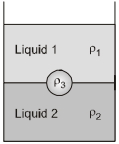
A jar is filled with two non-mixing liquids $1$ and $2$ having densities $\rho_1$ and, $\rho_2$ respectively. A solid ball, made of a material of density $\rho_3$ , is dropped in the jar. It comes to equilibrium in the position shown in the figure.Which of the following is true for $\rho_1 , \rho_2$ and $\rho_3$?
If in a stationary wave the amplitude corresponding to antinode is $4 \,cm$, then the amplitude corresponding to a particle of medium located exactly midway between a node and an antinode is ........... $cm$
Two infinitely long parallel wires having linear charge densities ${\lambda _1}$ and ${\lambda _2}$ respectively are placed at a distance of $R$ metres. The force per unit length on either wire will be $\left( {K = \frac{1}{{4\pi {\varepsilon _0}}}} \right)$
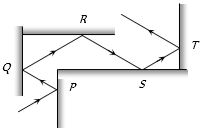
Following figure shows the multiple reflections of a light ray along a glass corridor where the walls are either parallel or perpendicular to one another. If the angle of incidence at point $P$ is $30^o $, what are the angles of reflection of the light ray at points $Q, R, S$ and $T$ respectively
Which of the following statements is incorrect?