Question

Image

Answer

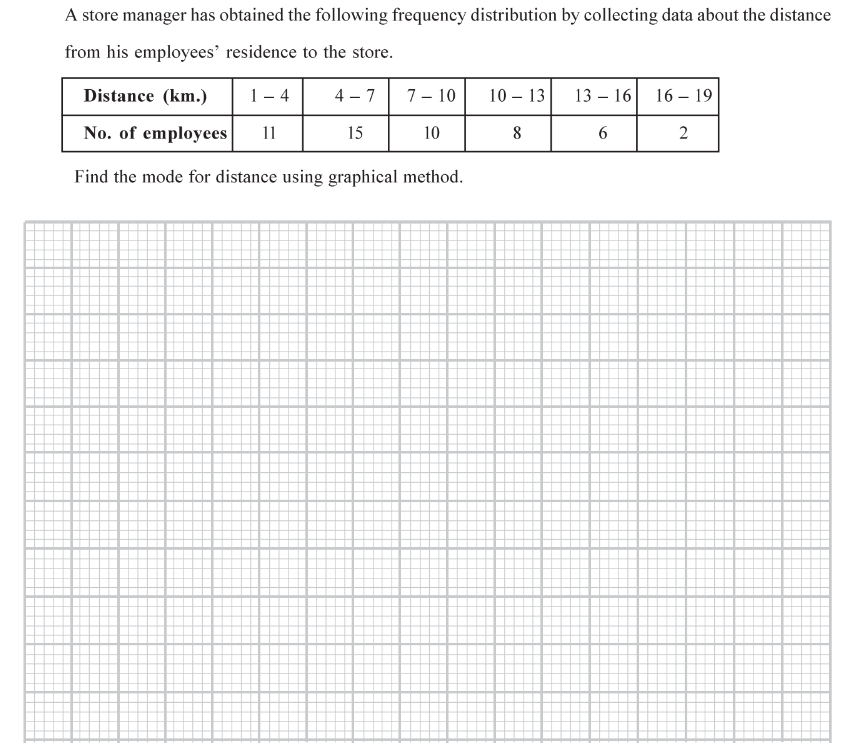
$M_{ o }=5.3 \ km$

Need a full question paper?

Generate a complete, print-ready paper with questions like this in minutes — across 16+ boards, with answer keys.

Start Generating Free

Similar questions

The following table shows data about the distance travelled: (in km) by a salesman on different days. Find median, $Q_3, D_8, P_{62}$ and interpret them:
Distance travelled (km) $0 – 100$ $100 – 200$ $200 – 300$ $300 – 400$ $400 – 500$ $500 - 600$
No. of days $5$ $18$ $24$ $7$ $5$ $1$
We obtain the cumulative frequency distribution for the given frequency distribution.
Using binomial expansion show that, $(\sqrt{7}+1)^{5}-$ $(\sqrt{7}-1)^{5}=632$
The students of standard $11$ have collected the data about profits (in crore Rs.) of $IT$ companies.
Find Karl Pearson's coefficient of skewness from these data and interpret it.
Profit (crore₹)
$5-7$ $7-9$ $9-11$ $11-13$ $13-15$ $15-17$
No. of companies
$5$ $12$ $20$ $8$ $3$ $2$
Image
Find the Value of the following using binomial expansion: $(2+\sqrt{5})^{5}+(2-\sqrt{5})^{5}$
For two groups $T_{1}$ and $T_{2}$, taking $A =25$ the following information are obtained:
Group $T_{1}: n_{1}=10 ; \sum d=30 ; \sum d^{2}=12340$
Group $T_{2}: n_{2}=20 ; \sum d=-20 ; \sum d^{2}=24520$
Marks obtained by $50$ students in a test of $50$ marks are as follows :
$\text{16 18 27 31 43 25 28 30 29 15}$
$\text{20 27 31 34 39 41 22 28 31 16}$
$\text{21 29 38 24 30 24 26 17 30 22}$
$\text{28 35 23 18 24 32 37 27 32 38}$
$\text{19 25 33 25 29 25 34 45 26 24}$
$(i)$ From these data, prepare a frequency distribution by taking class length $5$ .
$(ii)$ Obtain 'less than' and 'more than' type cumulative frequency distribution.
$(iii)$ If standard of passing is $20$ marks, then how many students have failed ?
$(iv)$ If at least $30$ marks are required to get first class, find the number of students in this category.
The information of profits (in lakh $?$) of $50$ firms in the last year is given below. Find the standard deviation of the profit of the firms.
Image
Find an appropriate measure of dispersion from the following data. Also find its relative measure.
Marks Less than $10$ $10 – 20$ $20 – 30$ $30 – 40$ Above $40$
No. of students $2$ $4$ $10$ $3$ $1$
$20$ workers of a factory get bonus from $₹ 1000$ to $₹ 5000$ as per their performance. Its distribution is as follows.
Bonus (₹) $1000$ $2000$ $3000$ $4000$ $5000$
No. of workers $3$ $5$ $6$ $4$ $2$

Obtain coefficient of range, quartile deviation and standard deviation for the bonus.