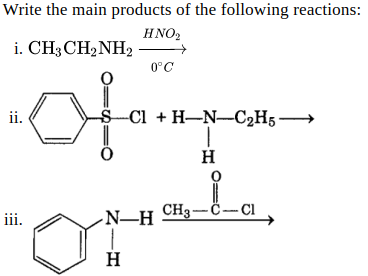
Question
Image

Answer

Get the step-by-step solution for this question inside the Vidyadip app.

Get the answer in the app

Need a full question paper?

Generate a complete, print-ready paper with questions like this in minutes — across 16+ boards, with answer keys.

Start Generating Free

Similar questions

Concentration terms such as mass percentage, ppm, mole fraction and molality are independent of temperature, however molarity is a function of temperature. Explain.
Explain different types of isomerism in amines.
[A], [B], [C], [D], [E], [F] and [G] are amines each of which forms a hydrochloride containing 32.42% chlorine. [A], [B], [C] and [D] evolve N2 on reaction with HNO2, but [E], [F], [G] and [H] do not. Give structures of [A] to [H] with reasons.
Write a detailed note on enzymes.
Explain the following terms with suitable examples:
(a) Cationic detergents, (b) Anionic detergents, (c) Neutral detergents.
CoSO4Cl.5NH3 exists in two isomeric forms 'A' and 'B'. Isomer 'A' reacts with AgNO3 to give white precipitate but does not react with BaCl2. Isomer 'B' gives a white precipitate with BaCl2 but does not react with AgNO3. Answer the following questions.
i. Identify 'A' and 'B' and write their structural formulas.
ii. Name the type of isomerism involved.
iii. Give the IUPAC name of 'A' and 'B'.
Explain the properties of vitamins and also classify them.
What is crystal field theory? On the basis of this, explain the crystal field splitting in octahedral coordinaton compounds.
Match the items of Column I and Column II on the basis of data given below:
$\text{E}^{\ominus}_{\text{F}_2/\text{F}^-}=2.87\text{V},\text{ E}^{\ominus}_{\text{Li}^+/\text{Li}}=-3.5\text{V},\text {E}^{\ominus}_{\text{Au}^{3+}/\text{Au}}=1.4\text{V},\text{ E}^{\ominus}_{ \text{Br}_2/\text{Br}^-}=1.09\text{V}$
 
Column I
 
Column II
i.
F2
a.
Metal is the strongest reducing agent.
ii.
Li
b.
Metal ion which is the weakest oxidising agent.
iii.
Au3+
c.
Non metal which is the best oxidising agent.
iv.
Br-
d.
Unreactive metal.
v.
Au
e.
Anion that can be oxidised by Au3+
vi.
Li+
f.
Anion which is the weakest reducing agent.
vii.
F-
g.
Metal ion which is an oxidising agent.
Explain the following terms:
(i) Coagulation
(ii) Electrophoresis
(iii) Tyndall Effect
(iv) Hardy Schulze's Rule