Question
$\frac{1}{2},-\frac{1}{2}$

Answer

Let $\alpha=\frac{1}{2}$ and $\beta=-\frac{1}{2}$
$\therefore \alpha+\beta=\frac{1}{2}-\frac{1}{2}=0 \text { and } \alpha \beta=\frac{1}{2} \times-\frac{1}{2}=-\frac{1}{4}$
$\therefore$ and quadratic equation is, $x ^2-(\alpha+\beta) x +\alpha \beta=0$
$\therefore x ^2-(0) x +\left(-\frac{1}{4}\right)=0$
$\therefore x ^2-\frac{1}{4}=0 $
$\therefore 4 x ^2-1=0$

Need a full question paper?

Generate a complete, print-ready paper with questions like this in minutes — across 16+ boards, with answer keys.
Start Generating Free

Similar questions

A share is sold for the market value of Rs 2000.Brokerage is paid at the rate of 0.5%. What is the amount received after the sale ?
Given : line $l \|$ line $m \|$ line $n$ $t_1$ and $t_2$ are transversals. Transversal $t_1$ intersects the lines in points A, B, C and $\mathrm{t}_2$ intersects the lines in points $\mathrm{P}$, Q, R. To prove : $\frac{\mathrm{AB}}{\mathrm{BC}}=\frac{\mathrm{PQ}}{\mathrm{QR}}$
Which of the following sequences are A.P ? If it is an A.P, find next two terms : $2,-2,-6,-10, \ldots$
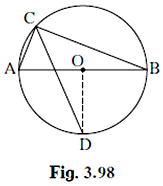
In figure 3.98, seg AB is a diameter of a circle with centre O . The bisector of∠ ACB intersects the circle at point D. Prove that, seg AD ≅seg BD.

Complete the following proof by filling in the blanks.
Proof: Draw seg OD.
$\angle ACB =\square \ldots 90^{\circ} \ldots \ldots \ldots . . \text { angle inscribed in semicircle }$
$\angle DCB =\square \ldots . . .45^{\circ} \ldots CD \text { is the bisector of } \angle C$
$m (\operatorname{arc} DB )=\square . . . .45^{\circ} \ldots \text { inscribed angle theorem }$
$\angle DOB =\square \ldots . . . .90^{\circ} \text { definition of measure of an arc (I) }$
$\operatorname{seg} OA \cong \operatorname{seg} OB \ldots \ldots . . \text { radii of the circle... } \square \text { (II) }$
$\therefore \text { line } OD \text { is } \square \text { of seg } AB . \ldots . . \text { bisector.... From (I) and (II) }$
$\therefore \text { seg } AD \cong \operatorname{seg} BD$
If $\sin\theta=\frac{4}{5},$ what is the value of $\cot\theta+\text{cosec }\theta?$
Prove that:
$\frac{\sin18^\circ}{\cos72^\circ}+\sqrt{3}\big(\tan10^\circ\tan30^\circ\tan40^\circ\tan50^\circ\tan80^\circ\big)=2$
If the mean of the frequency distribution is 8.1 and ∑𝑓𝑖𝑥𝑖 = 132 + 5k, ∑ 𝑓𝑖= 20 then find K.
In $\triangle \mathrm{ABC}$, ray $\mathrm{BD}$ bisects $\angle \mathrm{ABC}$. $A-D-C$, side DE $\|$ side $B C, A-E-B$ then prove that, $\frac{A B}{B C}=\frac{A E}{E B}$
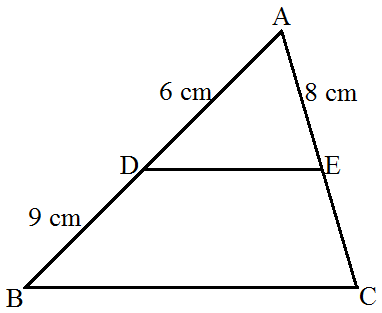
In the adjoining figure, find AC.
A Wire when bent in the form of an equilateral triangle encloses an area of $121\sqrt{3}\text{cm}^2.$ If the same wire is bent into the form of a circle, what will be the area of the circle? $\Big[\text{Take }\pi=\frac{22}{7}.\Big]$