Question

Image

Answer

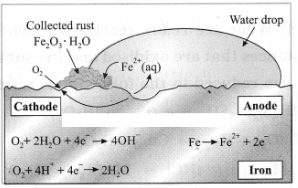
The rusting of iron is an oxidation process. The rust on iron does not form by a simple reaction between oxygen and iron surface. The rust is formed by an electrochemical reaction. Fe oxidises to $Fe _2 O _3 . H _2 O$ on one part of iron surface while oxygen gets reduced to $H _2 O$ on another part or surface, Different regions on the surface of iron become anode and cathode.
(1) $Fe$ is oxidised to $Fe ^{2+}$ in the anode region.
$
Fe _{( s )} \rightarrow Fe ^{2+}{ }_{( aq )}+2 e ^{-}
$
(2) $O _2$ is reduced to form water in the cathode region.
$
O _{2(g)}+4 H ^{+}( aq )+4 e -\rightarrow 2 H _2 O _{(1)}
$
When $Fe ^{2+}$ ions migrate from the anode region they react with water and futher get oxidised to form $Fe ^{3+}$ ions.
A reddish coloured hydrated oxide is formed from $Fe ^{3+}$ ions. It is called rust. It collects on the
surface.
$2 Fe ^{3+}( aq )+4 H _2 O _{( l )} \rightarrow Fe _2 O _3 \cdot H _2 O _{( s )}+6 H ^{+}( aq ) \cdots$
Because of various components in the atmosphere, oxidation of metals takes place, consequently resulting in their damage. This is called 'corrosion'. Iron rusts and a reddish coloured layer is formed on it. This is corrosion of iron.

Need a full question paper?

Generate a complete, print-ready paper with questions like this in minutes — across 16+ boards, with answer keys.
Start Generating Free

Similar questions

Which problems does the common man face due to incidence of cyber crime?
Explain with examples types of asexual reproduction in unicellular organisms.
Consider the following substances $:NaCl, Ca(OH)_2, NaHCO_3, NH_3, Na_2CO, H_2O, Cl_2, CO_2, CaSO_4.2H_2O, 2CaSO_4.H_2O, CaOCl_2$
  1. Which two substances combine to form bleaching powder?
  2. Which four substances are utilised in the production of washing soda?
  3. Which compound represents plaster of Paris?
  4. Which compound is a part of baking powder?
  5. Which compound is used as an antacid?
What happens if there are no decomposers on the Earth?
Two resistors, with resistances $ 5 Ω$ and $10 Ω$ respectively are to be connected to a battery of emf $6V$ so as to obtain:
  1. Minimum current flowing.
  2. Maximum current flowing.
  1. How will you connect the resistances in each case?
  2. Calculate the strength of the total current in the circuit in the two cases.
Explain the following terms with example: Unsaturated hydrocarbons.
There are four tiny organisms A, B, C and D. The organism A is a parasitic protozoan which causes a disease known as kala-azar. The organism B is a microscopic single-celled animal which causes malaria disease in human beings. The organism C is a unicellular animal which can change its body shape according to need, it has no fixed shape. The organism D is also a unicellular animal which is slipper-shaped having a large number of tiny hair all around its body.
  1. Name the organisms A, B, C and D.
  2. Name one characteristic body feature of organism A.
  3. Name the insect which carries organism B and transmits it from one person to another.
  4. What name is given to the asexual method of reproduction of (i) organism A, and (ii) organism B?
  5. Where do organisms C and D live?
What do you understand by the term ‘evolution’? State Darwin’s theory of evolution.
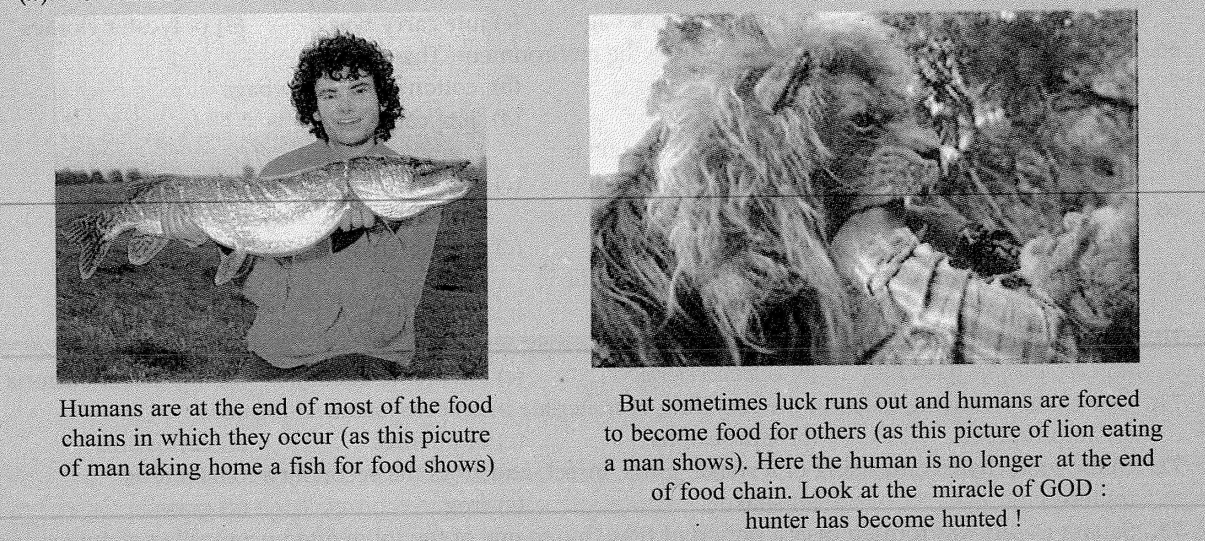
Some hunters are roaming in the plush green forest of Africa. They spot a deer and kill it. They decide to roast the deer there and then and eat it. When the hunters had just finished enjoying the feast of roasted deer, a lion attacks them. The lion kills one of the hunters and eats his flesh.
  1. Write a food chain which provides food to lion in this case.
  2. Which animal (other than deer) the lion could look for food if he did not get the hunter as prey?
  3. Which other animal in the forest could have been in place of lion?
  4. How does the above food chain differ form the food chain such as: plants → goat → man?
Explain the working of an astronomical telescope using refraction of light.