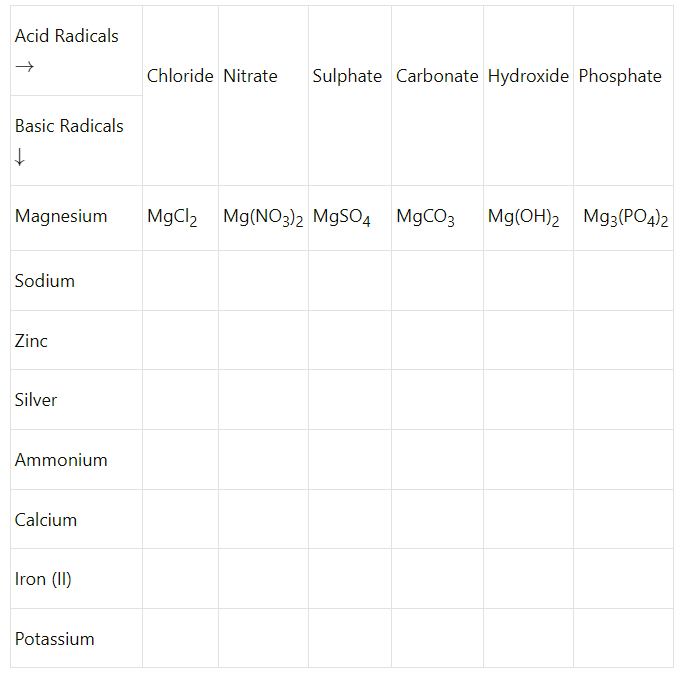
Question
Image

Answer


Acid Radicals `→`


Chloride


Nitrate


Sulphate


Carbonate


Hydroxide


Phosphate

Basic Radicals `↓`

Sodium

$NaCl$

$NaNO_3$

$Na_2SO_4$

$Na_2CO_3$

$NaOH$

$Na_3PO_4$

Zinc

$ZnCl_2$

$Zn(NO_3)_2$

$Zn(SO_4)$

$ZnCO_3$

$Zn(OH)_2$

$Zn_3(PO_4)_2$

Silver

$AgCl

$AgNO_3$

$Ag_2SO_4$

$Ag_2CO_3$

$AgOH$

$Ag_3PO_4$

Ammonium

$NH_4Cl$

$NH_4NO_3$

$(NH_4)_2SO_4$

$(NH_4)_2CO_3$

$NH_4OH$

$(NH)_3PO_4$

Calcium

$CaCl_2$

$Ca(NO_3)_2$

$CaSO_4$

$CaCO_3$

$Ca(OH)_2$

$Ca_3(PO_4)_2$

Iron (II)

$FeCl_2$

$Fe(NO_3)_2$
$FeSO_4$ $FeCO_3$
$Fe(OH)_2$

$Fe_3(PO_4)_2$

Potassium

$KCl$

$KNO_3$

$K_2SO_4$

$K_2CO_3$

$KOH$

$K_3PO_4$

Need a full question paper?

Generate a complete, print-ready paper with questions like this in minutes — across 16+ boards, with answer keys.

Start Generating Free

Similar questions

Give the composition, causes, and effects of acid rain.
Draw the orbital diagram of ${ }_{20}^{40} \mathrm{Ca}^{2+}$ ion and state the number of three fundamental particles present in it.
How can you say these are chemical changes? Give one reason for your answer.
Which will have greater volume when the following gases are compared at STP:
  1. $1.2/N_2$ at $25^\circC$ and $748$ mmHg
  2. $1.25/O_2$at STP
Match column A with column B.

Column A

Column B

(a) Element short by 1 electron in octet

(i) Transition elements

(b) Highly reactive metals

(ii) Noble gases

(c) Non-reactive elements

(iii) Alkali metals

(d) Elements of groups 3 to 12

(iv) Alkaline earth metals

(e) Radioactive elements

(v) Halogens

(f) Elements with 2 electrons in the outermost orbit

(vi)Actinides

A gas is to be filled from a tank of capacity 10,000 litres into cylinders each having capacity of 10 litres. The condition of the gas in the tank is as follows:
  1. The pressure inside the tank is 800 mm of Hg.
  2. The temperature inside the tank is −3°C.
When the cylinder is filled, the pressure gauge reads 400 mm of Hg and the temperature is 270 K. Find the number of cylinders required to fill the gas.
In the formation of (i) oxygen molecule (ii) carbon tetrachloride molecule, state the following:
  1. Electronic configuration of nearest inert gas attained.
  2. How many electrons are shared/transferred in bond formation
  3. Which type of bonds these compounds form?
  4. Draw their orbital diagrams.
State the main sources and effects of carbon monoxide.
A gas occupies $500 cm^3$ at a normal temperature. At what temperature will the volume of the gas be reduced by $20 \%$ of its original volume, the pressure is constant?
 $800 cm^3$ of gas is collected at 650 mm pressure. At what pressure would the volume of the gas reduce by $40 \%$ of its original volume, the temperature remaining constant?