A $10\, m$ long wire of $20\,\Omega$ resistance is connected with a battery of $3\, volt$ $e.m.f.$ (negligible internal resistance) and a $10 \,\Omega$ resistance is joined to it is series. Potential gradient along wire in volt per meter is
Medium


Download our appand get started for free
Experience the future of education. Simply download our apps or reach out to us for more information. Let's shape the future of learning together!No signup needed.*
Similar Questions
- 1A wire of resistance $20 \Omega$ is divided into $10$ equal parts. A combination of two parts are connected in parallel and so on. Now resulting pairs of parallel combination are connected in series. The equivalent resistance of final combination is_______.0$\Omega$.View Solution
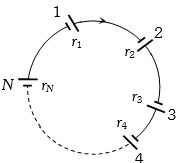
- 2A group of $N$ cells whose $emf$ varies directly with the internal resistance as per the equation $E_N = 1.5\, r_N$ are connected as shown in the figure below. The current $I$ in the circuit is ........... $amp$View Solution
- 3Three $60\, W$ light bulbs are mistakenly wired in series and connected to a $120\,V$ power supply. Assume the light bulbs are rated for single connection to $120\,V$. With the mistaken connection, the power dissipated by each bulb is: .................. $W$View Solution
- 4An electric bulb is designed to draw power $P_0$ at voltage $V_0$. If the voltage is $V$ it draws a power $P$. ThenView Solution
- 5Assertion : A larger dry cell has higher $emf$View Solution
Reason : The $emf$ of a dry cell is proportional to its size
- 6View SolutionA steel wire has a resistance twice that of an aluminium wire. Both of them are connected with a constant voltage supply. More heat will be dissipated in
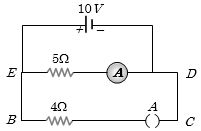
- 7In the given figure, when key $A$ is opened, the reading of the ammeter $A$ will be ........... $A$View Solution
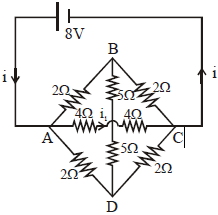
- 8The value of current $i_{1}$ flowing from $A$ to $C$ in the circuit diagram is$.......A$View Solution
- 9One $kg$ of water, at $20\,^oC$, is heated in an electric kettle whose heating element has a mean (temperature averaged) resistance of $20\, \Omega $. The rms voltage in the mains is $200\, V$. Ignoring heat loss from the kettle, time taken for water to evaporate fully, is close to.......... $\min$ [Specific heat of water $= 4200\, J/kg\, ^oC$), Latent heat of water $= 2260\, k\,J/kg$]View Solution
- 10A $25\, watt$, $220\, volt$ bulb and a $100\, watt$, $220\, volt$ bulb are connected in parallel across a $220\, volt$ line. Which bulb will glow more brightlyView Solution