A ($100\, W$, $200\, V$) bulb is connected to a $160\, V$ power supply. The power consumption would be ............. $W$
AIPMT 1997, Medium


Download our appand get started for free
Experience the future of education. Simply download our apps or reach out to us for more information. Let's shape the future of learning together!No signup needed.*
Similar Questions
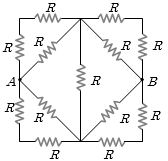
- 1Thirteen resistances each of resistance $R\, ohm$ are connected in the circuit as shown in the figure below. The effective resistance between $A$ and $B$ isView Solution
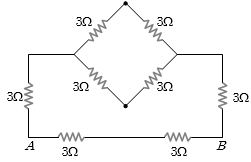
- 2Equivalent resistance between $A$ and $B$ will be ............ $ohm$View Solution
- 3By a cell a current of $0.9\, A$ flows through $2\, ohm$ resistor and $0.3\,A$ through $7\, ohm$ resistor. The internal resistance of the cell is ............ $\Omega$View Solution
- 4View SolutionSelect the correct statement
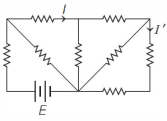
- 5Consider the following circuit shown below. All the resistors are identical. The ratio of $I / I^{\prime}$ isView Solution
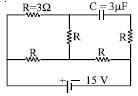
- 6In the circuit shown, the cell is ideal, with $emf$ $=$ $15$ $V$. Each resistance is of $3 $ $\Omega$ . The potential difference across the capacitor is.....$V$View Solution
- 7$A$ wire of cross-section area $A$, length $L_1$, resistivity $\rho_1$ and temperature coefficient of resistivity $\alpha_1$ is connected to a second wire of length $L_2$, resistivity $\rho_2$ , temperature coefficient of resistivity $\alpha_1$ and the same area $A$, so that wire carries same current. Total resistance $R$ is independent of temperature for small temperature change if (Thermal expansion effect is negligible)View Solution
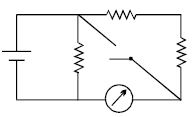
- 8In the circuit shown, the reading of the Ammeter is doubled after the switch is closed. Each resistor has a resistance $ = 1\,\Omega $ and the ideal cell has an $e.m.f. = 10\, V$. Then, the Ammeter has a coil resistance equal to ................ $\Omega$View Solution
- 9$32$ cells, each of $emf$ $3V$, are connected in series and kept in a box. Externally, the combination shows an $emf$ of $84\, V$. The number of cells reversed in the combination isView Solution
- 10A resistor ${R_1}$ dissipates the power $P$ when connected to a certain generator. If the resistor ${R_2}$ is put in series with ${R_1}$, the power dissipated by ${R_1}$View Solution