A $100\, watt$ bulb working on $200 \,volt$ and a $200\, watt$ bulb working on $100\, volt$ have
Medium
Download our app for free and get started
(b) $R = \frac{{{V^2}}}{P}$ $ \Rightarrow $ ${R_1} = \frac{{200 \times 200}}{{100}} = 400\,\Omega $ and
${R_2} = \frac{{100 \times 100}}{{200}} = 50\,\Omega .$ Maximum current rating $i = \frac{P}{V}$
So ${i_1} = \frac{{100}}{{200}}$ and ${i_2} = \frac{{200}}{{100}}$$ \Rightarrow $ $\frac{{{i_1}}}{{{i_2}}} = \frac{1}{4}$.
${R_2} = \frac{{100 \times 100}}{{200}} = 50\,\Omega .$ Maximum current rating $i = \frac{P}{V}$
So ${i_1} = \frac{{100}}{{200}}$ and ${i_2} = \frac{{200}}{{100}}$$ \Rightarrow $ $\frac{{{i_1}}}{{{i_2}}} = \frac{1}{4}$.

Download our appand get started for free
Experience the future of education. Simply download our apps or reach out to us for more information. Let's shape the future of learning together!No signup needed.*
Similar Questions
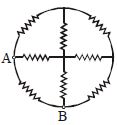
- 1Eight resistances each of resistance $5\,\Omega $ are connected in the circuit as shown in figure. The equivalent resistance between $A$ and $B$ isView Solution
- 2Two cells of emf $E_1$ and $E_2\left(E_1 > E_2\right)$ are connected individually to a potentiometer and their corresponding balancing length are $625 \,cm$ and $500 \,cm$, then the ratio $\frac{E_1}{E_2}$ is ...........View Solution
- 3View SolutionThe resistivity of a wire depends on its
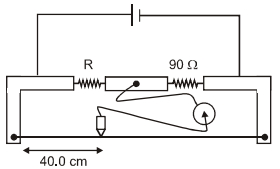
- 4During an experiment with a metre bridge, the galvanometer shows a null point when the joceky is pressed at $40.0 \ cm$ using a standard resistance of $90 \ \Omega$, as shown in the figure. The least count of the scale used in the meter bridge is $1 \ mm$. The unknown resistance is:View Solution
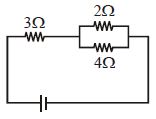
- 5If power in $3\,\Omega $ is $27\,W$ then what is the power in $2\,\Omega $ ................. $W$View Solution
- 6The current density in a cylindrical wire of radius $r=4.0 \,mm$ is $1.0 \times 10^{6} \,A / m ^{2}$. The current through the outer portion of the wire between radial distances $r / 2$ and $r$ is $x \pi A$; where $x$ is ..........View Solution
- 7A metal wire of resistance $3\,\Omega $ is elongated to make a uniform wire of double its previous length. The new wire is now bent and the ends joined to make a circle. If two points on this circle make an angle $60^o$ at the centre, the equivalent resistance between these two points will beView Solution
- 8A certain wire has a resistance $R$. The resistance of another wire identical with the first except having twice its diameter isView Solution
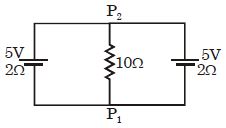
- 9Find the current in the $10\, \Omega$ resistanceView Solution
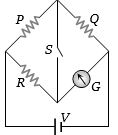
- 10In the circuit shown $P \ne R$, the reading of the galvanometer is same with switch $S$ open or closed. ThenView Solution