Question
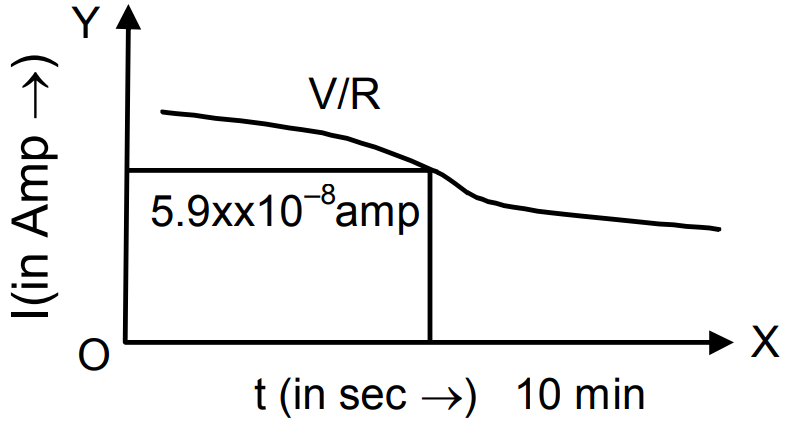
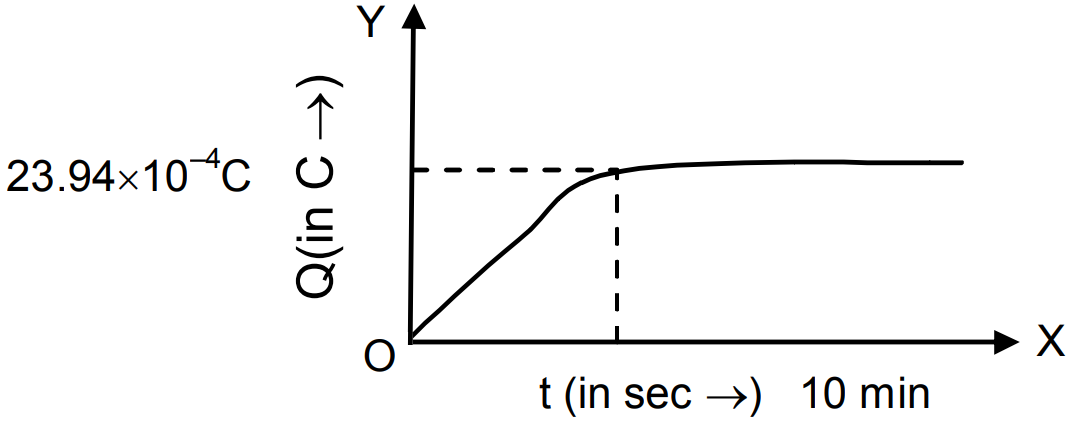
A $100\mu\text{F}$ capacitor is joined to a 24V battery through a $1.0\text{M}\Omega$ resistor. Plot qualitative graphs (a) between current and time for the first 10 minutes and (b) between charge and time for the same period.
Answer

Time constant $\text{RC} = 1 \times 10^6 \times 100 \times 10^6 = 100 \text{sec}$
  1. $\text{q}=\text{VC}\Big(1-\text{e}^{\frac{-\text{t}}{\text{CR}}}\Big)$


I = Current $=\frac{\text{dq}}{\text{dt}}=\text{VC}.(-)\text{e}^{\frac{-\text{t}}{\text{RC}}},\frac{-1}{\text{RC}}$

$=\frac{\text{V}}{\text{R}}\text{e}^{\frac{-\text{t}}{\text{RC}}}=\frac{\text{V}}{\text{R}\cdot\text{e}^{\frac{\text{t}}{\text{RC}}}}=\frac{24}{10^6}\times\frac{1}{\text{e}^{\frac{\text{t}}{100}}}$

$=24\times10^{-6}\frac{1}{\text{e}^{\frac{\text{t}}{100}}}$

$\text{t}=10\text{min},600\text{sec}.$


$\text{Q}=24\times10+-4\times\big(1-\text{e}^{-6}\big)=23.99\times10^{-4}$

$\text{I}=\frac{24}{10^6}\times\frac{1}{\text{e}^6}=5.9\times10^{-8}\text{Amp}.$
  1. $\text{q}=\text{VC}\Big(1-\text{e}^\frac{-\text{t}}{\text{CR}}\Big)$

Need a full question paper?

Generate a complete, print-ready paper with questions like this in minutes — across 16+ boards, with answer keys.

Start Generating Free

Similar questions

The driver of a three-wheeler moving with a speed of 36km/h sees a child standing in the middle of the road and brings his vehicle to rest in 4.0s just in time to save the child. What is the average retarding force on the vehicle ? The mass of the three-wheeler is 400kg and the mass of the driver is 65kg.
A thin prism of angle $6.0^\circ,\omega=0.07$ and $\mu_\text{y}=1.50$ is combined with another thin prism having $\omega=0.08$ and $\mu_\text{y}=1.60.$ The combination produces no deviation in the mean ray.
  1. Find the angle of the second prism.
  2. Find the net angular dispersion produced by the combination when a beam of white light passes through it.
  3. If the prisms are similarly directed, what will be the deviation in the mean ray
  4. Find the angular dispersion in the situation described in (c).
Define linear momentum. Prove that for fixed mass, $P \propto v$ and for constant momentum $v \propto \frac{1}{m}$.
Two ideal gas thermometers A and B use oxygen and hydrogen respectively. The following observations are made:
Temperature
Pressure thermometer A
Pressure thermometer B
Triple-point of water
$1.250 \times 10^5Pa$
$0.200 \times 10^5Pa$
Normal melting point of sulphur
$1.797 \times 10^5Pa$
$0.287 \times 10^5Pa$
What is the absolute temperature of normal melting point of sulphur as read by thermometers A and B?
What do you think is the reason behind the slight difference in answers of thermometers A and B? (The thermometers are not faulty). What further procedure is needed in the experiment to reduce the discrepancy between the two readings?
The temperatures of equal masses of three different liquids $A , B$ and C are $12^{\circ} C , 19^{\circ} C$ and $28^{\circ} C$ respectively. The temperature when A and B are mixed is $16^{\circ} C$, and when B and C are mixed, it is $23^{\circ} C$. What will be the temperature when A and C are mixed?
Explain Aristotle's Fallacy and Galileo's refutation.
A capacitance C, a resistance R and an emf $\in$ are connected in series at t = 0. What is the maximum value of (a) the potential difference across the resistor (b) the current in the circuit (c) the potential difference across the capacitor (d) the energy stored in the capacitor (e) the power delivered by the battery and (f) the power converted into heat?
Find the speed of an electron with kinetic energy:
  1. 1eV
  2. 10keV
  3. 10MeV
A person normally weighing $50kg$ stands on a massless platform which oscillates up and down harmonically at a frequency of $2.0s^{–1}$ and an amplitude $5.0cm$. A weighing machine on the platform gives the persons weight against time.
  1. Will there be any change in weight of the body, during the oscillation?
  2. If answer to part (a) is yes, what will be the maximum and minimum reading in the machine and at which position?
Figure $5.17$ shows the position-time graph of a body of mass $0.04kg$. Suggest a suitable physical context for this motion. What is the time between two consecutive impulses received by the body? What is the magnitude of each impulse?