Question
A $4.2\ m$ wide road surrounds a circular plot whose circumference is $176\ m.$ Find the cost of paving the road at $Rs.75$ per $m^2.$
Answer

We know,
Image
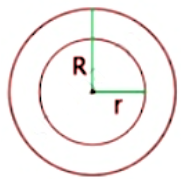
The area of the ring between two concentric circles equals the area of the larger circle minus the area of smaller circle.
Let the radius of the outer and inner ring be $R$ and $r$ respectively.
Here the circular garden is the inner circle and the $7\ m$ wide road is the ring
The Circumference of a Circle with radius $r=2 \pi r$
Here,
$2 \pi r=176$
$\Rightarrow r=\frac{176}{2 \pi}$
$=\frac{176 \times 7}{2 \times 22}$
$=28$
$\Rightarrow r=28\ m$
$\Rightarrow R=28+4.2$
$=32.2\ m $
inner Circle has radius $r$
$=28 m$ and outer Circle has radius $R$
$=32.2\ m$
$ \pi\left(32.2^2-28^2\right)$
$=\frac{22}{7} \times(1036.84-784)$
$=\frac{22}{7} \times 252.84 $
$=794.64\ m ^2$
The cost of paving the road at the rate of $Rs. 150$ per $m ^2$
$=794.64 \times 75$
$=\text { Rs. } 59,598 .$

Need a full question paper?

Generate a complete, print-ready paper with questions like this in minutes — across 16+ boards, with answer keys.
Start Generating Free

Similar questions

In the following equations, verify if the given value is a solution of the equation: $2 \frac{1}{2} x+3 \frac{1}{2} x=56,2 x ; x=7$
The number of sides of two regular polygons are in the ratio $2 : 3$ and their interior angles are in the ratio $9 : 10$. Find the number of sides of each polygon.
If $L$ and $M$ are the mid$-$points of $AB,$ and $DC$ respectively of parallelogram $\text{ABCD}$. Prove that segment $DL$ and $BM$ trisect diagonal $AC.$
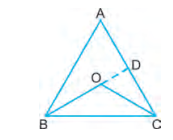
In the adjoining figure, in $\triangle A B C, O$ is any point in its interior. Show that: $OB + OC < AB + AC$.
Image
The volume of a cylinder of height $8 \ cm$ is $392 \pi \ cm^3$. Find its lateral surface area and its total surface area.
In a parallelogram $\text{ABCD}$, point $P$ lies in $DC$ such that $DP: PC = 3:2$. If the area of $\triangle DPB = 30 sq. \ cm$.find the area of the parallelogram $\text{ABCD}.$
In a right$-$angled $\triangle P Q R$, right$-$angled at $Q, S$ and $T$ are points on $P Q$ and $Q R$ respectively such as $P T=S R=13\ cm , Q T=5 \ cm$ and $P S=T R$. Find the length of $P Q$ and $P S$.
If $x=(100)^a, y=(10000)^b$ and $z=(10)^c$, find $\log \frac{10 \sqrt{y}}{x^2 z^3}$ in terms of $a$, $\mathrm{b}$ and $\mathrm{c}$.
Draw the graph for the equation given below; hence find the co$-$ordinates of the points where the graph is drawn meets the co$-$ordinates axes:$\frac{1}{3} x+\frac{1}{5} y=1$.
Use graph paper for this question. Take $2 \ cm = 2$ units on $x-$axis and $2 \ cm = 1$ unit on $y-$axis.Solve graphically the following equation:$3x + 5y = 12; 3x - 5y + 18 = 0 ($Plot only three points per line$)$