A $5\, kg$ collar is attached to a spring of spring constant $500\, Nm^{-1}$. It slides without friction over a horizontal rod. The collar is displaced from its equillibrium position by $10\, cm$ and released. The time period of oscillation is
Medium


Download our appand get started for free
Experience the future of education. Simply download our apps or reach out to us for more information. Let's shape the future of learning together!No signup needed.*
Similar Questions
- 1A particle executes $S.H.M$ between $x =\, -A$ to $x =\, +A$ . The time taken for it in going from $0$ to $A/2$ is $T_1$ and from $A/2$ to $A$ is $T_2$. ThenView Solution
- 2The amplitude of a particle executing $SHM$ about $O$ is $10\, cm.$ Then :View Solution
- 3View SolutionWhich of the following function represents a simple harmonic oscillation
- 4View SolutionThe velocity of a particle performing simple harmonic motion, when it passes through its mean position is
- 5Which one of the following statements is true for the speed $v$ and the acceleration $a$ of a particle executing simple harmonic motionView Solution
- 6Time period of a particle executing $SHM$ is $8\, sec.$ At $t = 0$ it is at the mean position. The ratio of the distance covered by the particle in the $1^{st}$ second to the $2^{nd}$ second is :View Solution
- 7What is the period of small oscillations of the block of mass $m$ if the springs are ideal and pulleys are massless ?View Solution
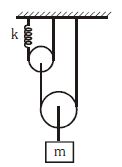
- 8The function ${\sin ^2}(\omega t)$ representsView Solution
- 9Which of the following expressions corresponds to simple harmonic motion along a straight line, where $x$ is the displacement and $a, b, c$ are positive constants?View Solution
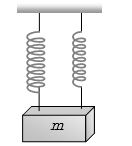
- 10A mass $m$ is suspended separately by two different springs of spring constant $K_1$ and $K_2$ gives the time-period ${t_1}$ and ${t_2}$ respectively. If same mass $m$ is connected by both springs as shown in figure then time-period $t$ is given by the relationView Solution