MCQ
A $50\, ohm$ galvanometer gets full scale deflection when a current of $0.01\, A$ passes through the coil. When it is converted to a $10\, A$ ammeter, the shunt resistance is ........... $\Omega $
  • A
    $0.01$ 
  • $0.05$
  • C
    $2000$ 
  • D
    $5000$ 

Answer

Correct option: B.
$0.05$
b
(b) ${i_g} = i\frac{S}{{G + S}}$

$ \Rightarrow $$\frac{{0.01}}{{10}} = \frac{5}{{50 + S}}$

$ \Rightarrow $ $S = \frac{{50}}{{999}} = 0.05\,\Omega $.

Need a full question paper?

Generate a complete, print-ready paper with questions like this in minutes — across 16+ boards, with answer keys.
Start Generating Free

Similar questions

The coefficient of self induction of a coil is given by.
The speed at which the image of the luminous point object is moving, if the luminous point object is moving at speed $v_0$ towards a spherical mirror, along its axis is (Given, $r =$ radius of curvature $u =$ object distance)
in radio theraphy, $X-$ rays are used to
The graph which shows the variation of $\left(\frac{1}{\lambda^2}\right)$ and its kinetic energy, $E$ is (where $\lambda$ is de Broglie wavelength of a free particle):
The collector plate in an experiment on photoelectric effect is kept vertically above the emitter plate. Light source is put on and a saturation photocurrent is recorded. An electric field is switched on which has a vertically downward direction.
Time taken by light to travel in two different materials $A$ and $B$ of refractive indices $\mu_{A}$ and $\mu_{B}$ of same thickness is $t_{1}$ and $t_{2}$ respectively. If $t_{2}-t_{1}=5 \times 10^{-10}$ s and the ratio of $\mu_{A}$ to $\mu_{B}$ is $1: 2$. Then the thickness of material, in meter is: (Given $v_{A}$ and $v_{B}$ are velocities of light in $A$ and $B$ materials respectively).
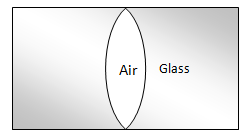
In the figure, an air lens of radii of curvature 10 cm ($\mathrm{R}_1=\mathrm{R}_2=10 \mathrm{~cm}$) is cut in a cylinder of glass (μ = 1.5). The focal length and the nature of the lens is
The velocity of light emitted by a source S observed by an observer O, who is at rest with respect to S is c. If the observer moves towards S with velocity v, the velocity of light as observed will be
Two charges of equal magnitudes and at a distance r exert a force F on each other. If the charges are halved and distance between them is doubled, then the new force acting on each charge is
An achromatic telescope objective is to be made by combining the lenses of flint and crown glasses. This proper choice is