Question
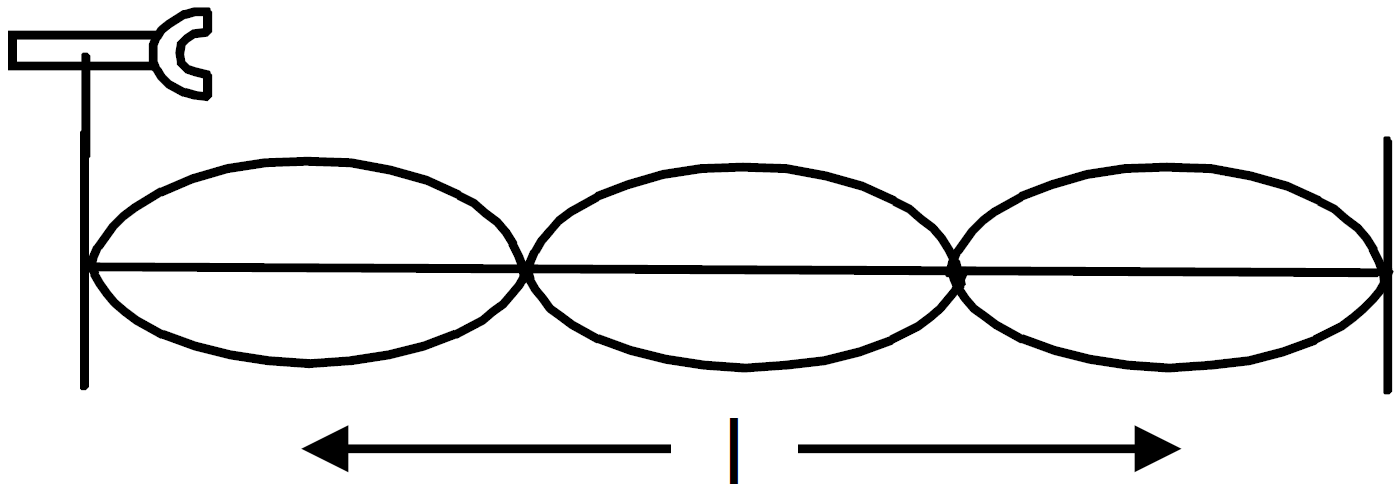
A 660Hz tuning fork sets up vibration in a string clamped at both ends. The wave speed for a transverse wave on this string is 220m/s and the string vibrates in three loops.
  1. Find the length of the string.
  2. If the maximum amplitude of a particle is 0.5cm, write a suitable equation describing the motion.
Answer

Frequency of the tuning fork, $\text{f}=660\text{Hz}$

Wave speed, $\text{v}=220\text{ms}$

$\Rightarrow\lambda=\frac{\text{v}}{\text{f}}=\frac{1}{3}\text{m}$

No.of loops = 3

  1. So, $\text{f}=\Big(\frac{3}{2\text{l}}\Big)\text{v}$

$\Rightarrow\text{l}=50\text{cm}$

  1. The equation of resultant stationary wave is given by

$\text{y}=2\text{A}\cos\Big(\frac{2\pi\text{x}}{\text{Ql}}\Big)\sin\Big(\frac{2\pi\text{vt}}{\lambda}\Big)$

$\Rightarrow\text{y}(0.5\text{cm})\cos(0.06\pi\text{cm}^{-1})\sin(1320\pi\text{s}^{-1})$

Need a full question paper?

Generate a complete, print-ready paper with questions like this in minutes — across 16+ boards, with answer keys.

Start Generating Free

Similar questions

A light ray falling at an angle of 45° with the surface of a clean slab of ice of thickness 1m is refracted into it at an angle of 30°. Calculate the time taken by the light rays, to cross the slab. Speed of light in vacuum = 3 × 10⁸m/s
A carrom board (4ft × 4ft square) has the queen at the centre. The queen, hit by the striker moves to the front edge, rebounds and goes in the hole behind the striking line. Find the magnitude of displacement of the queen:
  1. From the centre to the front edge.
  2. From the front edge to the hole.
  3. From the centre to the hole.
Equal masses of air are sealed in two vessels, one of volume V0 and the other of volume 2V0. If the first vessel is maintained at a temperature 300K and the other at 600K, find the ratio of the pressures in the two vessels.
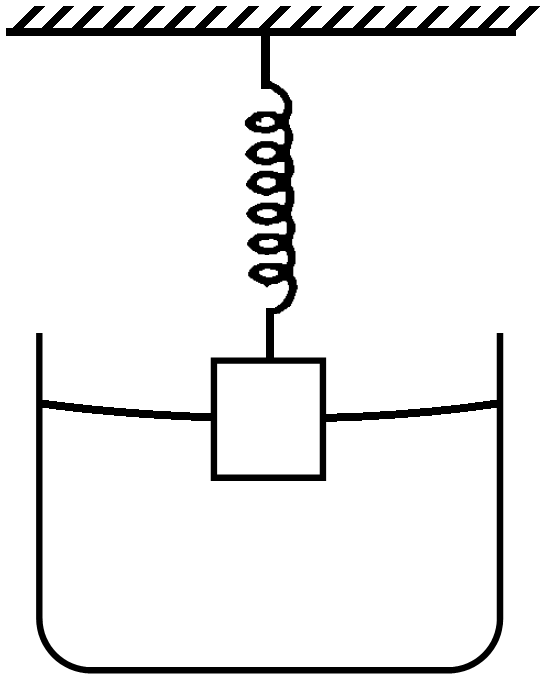
A cylindrical object of outer diameter 10cm, height 20cm and density 8000kg/m3 is supported by a vertical spring and is half dipped in water as shown in.
  1. Find the elongation of the spring in equilibrium condition.
  2. If the object is slightly depressed and released, find the time period of resulting oscillations of the object. The spring constant = 500N/m.

Find moment of inertia of a thin rod about an axis perpendicular to it and passing through its mid-point.
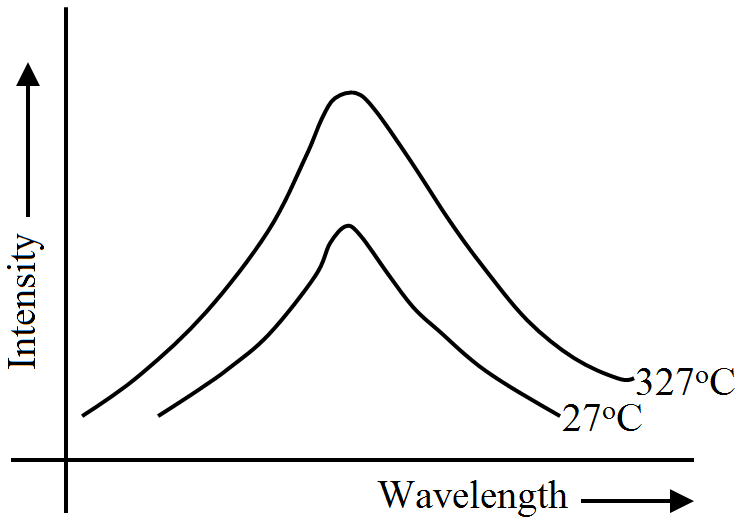
The spectrum of a black body at two temperatures 27°C and 327°C is shown in the figure. Let A1 and A2 be the respective areas under the two curves. Estimate the ratio $\frac{\text{A}_2}{\text{A}_1}.$

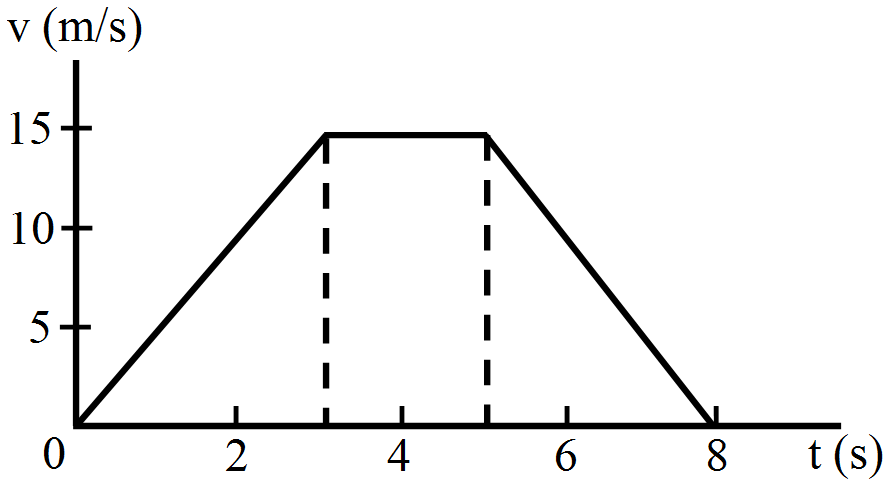
A particle of mass 50g moves on a straight line. The variation of speed with time is shown in figure. Find the force acting on the particle at t = 2, 4 and 6 seconds.

A ball is given a speed v on a rough horizontal surface. The ball travels through a distance l on the surface and stops.
  1. What are the initial and final kinetic energies of the ball?
  2. What is the work done by the kinetic friction?
Two equal and opposite forces act on a rigid body. Under what conditions will the body (i) rotate (ii) not rotate?
228Th emits an alpha particle to reduce to 224Ra. Calculate the kinetic energy of the alpha particle emitted in the following decay:

$\text{ }^{228}\text{Th}\rightarrow\text{ }^{224}\text{Ra}^*+\alpha$

$\text{ }^{224}\text{Ra}^*\rightarrow\text{ }^{224}\text{Ra}+\gamma(217\text{kev}).$

Atomic mass of 228Th is 228.028726u, that of 224Ra is 224.020196u and that of $\text{ }^4_2\text{He}$ is 4.00260u.