Question
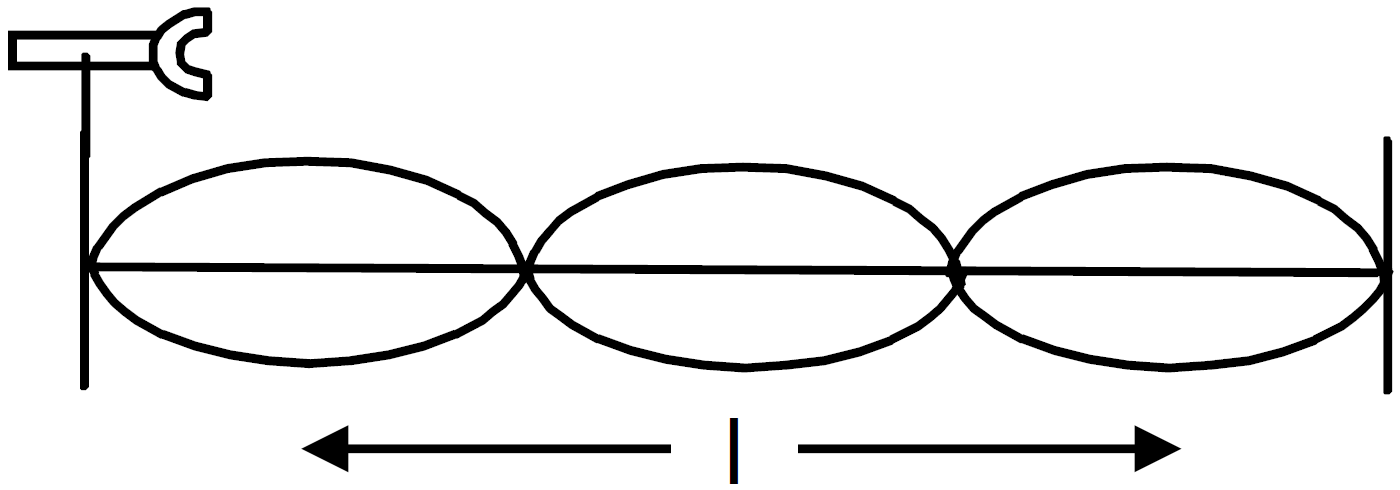
A 660Hz tuning fork sets up vibration in a string clamped at both ends. The wave speed for a transverse wave on this string is 220m/s and the string vibrates in three loops.
  1. Find the length of the string.
  2. If the maximum amplitude of a particle is 0.5cm, write a suitable equation describing the motion.
Answer

Frequency of the tuning fork, $\text{f}=660\text{Hz}$ Wave speed, $\text{v}=220\text{ms}$$\Rightarrow\lambda=\frac{\text{v}}{\text{f}}=\frac{1}{3}\text{m}$
No.of loops = 3
  1. So, $\text{f}=\Big(\frac{3}{2\text{l}}\Big)\text{v}$
$\Rightarrow\text{l}=50\text{cm}$
  1. The equation of resultant stationary wave is given by
$\text{y}=2\text{A}\cos\Big(\frac{2\pi\text{x}}{\text{Ql}}\Big)\sin\Big(\frac{2\pi\text{vt}}{\lambda}\Big)$
$\Rightarrow\text{y}(0.5\text{cm})\cos(0.06\pi\text{cm}^{-1})\sin(1320\pi\text{s}^{-1})$

Need a full question paper?

Generate a complete, print-ready paper with questions like this in minutes — across 16+ boards, with answer keys.

Start Generating Free

Similar questions

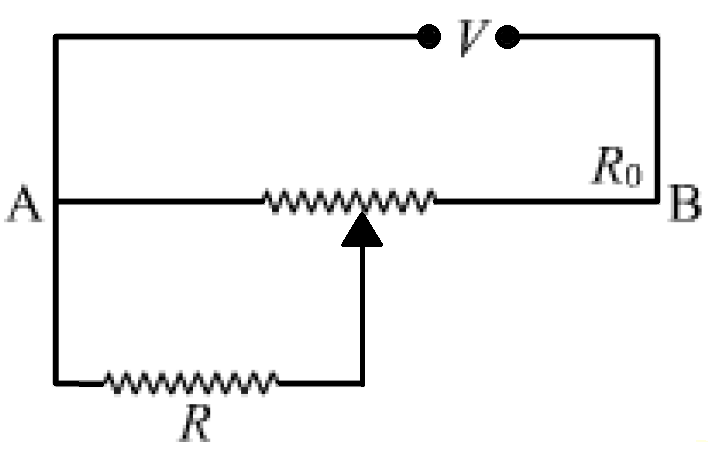
A resistance of R draws current from a potentiometer. The potentiometer wire, AB, has a total resistance of $R_o.$ A voltage V is supplied to the potentiometer. Derive an expression for the voltage across R when the sliding contact is in the middle of potentiometer wire.
  1. Why photoelectric effect can not be explained on the basis of wave nature of light? Give reasons.
  2. Write the basic features of photon picture of electromagnetic radiation on which Einstein’s photoelectric equation is based.
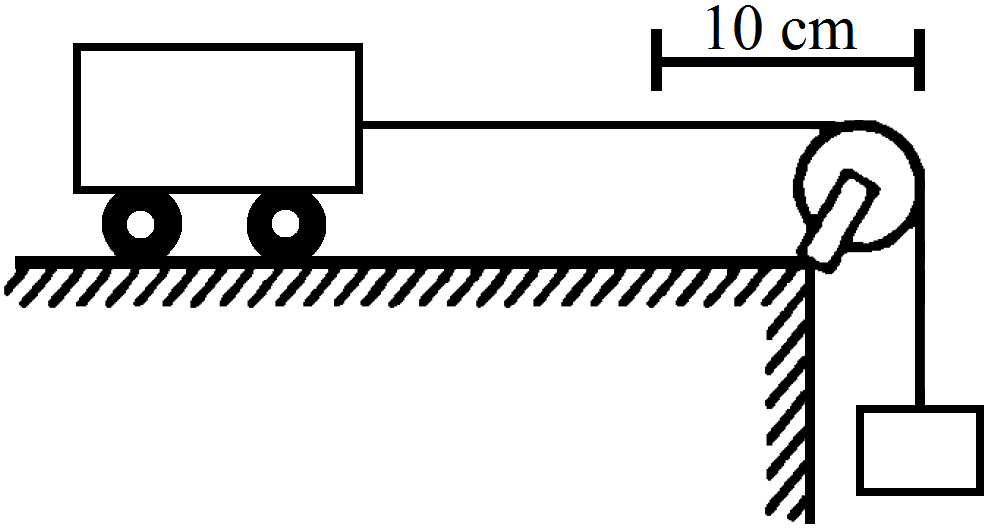
A heavy string is tied at one end to a movable support and to a light thread at the other end as shown in figure, The thread goes over a fixed pulley and supports a weight to produce a tension. The lowest frequency with which the heavy string resonates is 120Hz. If the movable support is pushed to the right by 10cm so that the joint is placed on the pulley, what will be the minimum frequency at which the heavy string can resonate?
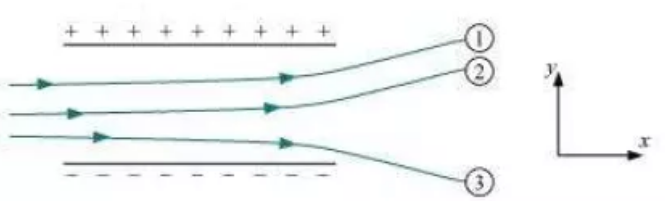
Figure 1.33 shows tracks of three charged particles in a uniform electrostatic field. Give the signs of the three charges. Which particle has the highest charge to mass ratio?
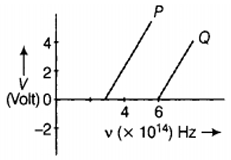
In the study of a photoelectric effect, the graph between the stopping potential $V$ and frequency of the incident radiation on two different metals $P$ and $Q$ is shown below.
Image

$i.$ Which one of the two metals has higher threshold frequency?
$ii.$ Determine the work function of the metal which has greater value.
In Joly's differential steam calorimeter, 3g of an ideal gas is contained in a rigid closed sphere at 20°C. The sphere is heated by steam at 100°C and it is found that an extra 0.095g of steam has condensed into water as the temperature of the gas becomes constant. Calculate the specific heat capacity of the gas in $Jg^{-1}\  K^{-1}.$ The latent heat of vaporisation of water $= 540cal-g^{-1}.$
The geostationary orbit of the earth is at a distance of about 36000km from the earth's surface. Find the weight of a 120kg equipment placed in a geostationary satellite. The radius of the earth is 6400km.
Find the electric field intensity due to a uniformly charged spherical shell at a point (i) outside the shell and (ii) inside the shell. Plot the graph of electric field with distance from the centre of the shell.
A thin prism is made of a material having refractive indices 1.61 and 1.65 for red and violet light. The dispersive power of the material is 0.07. It is found that a beam of yellow light passing through the prism suffers a minimum deviation of 4.0° in favourable conditions. Calculate the angle of the prism.
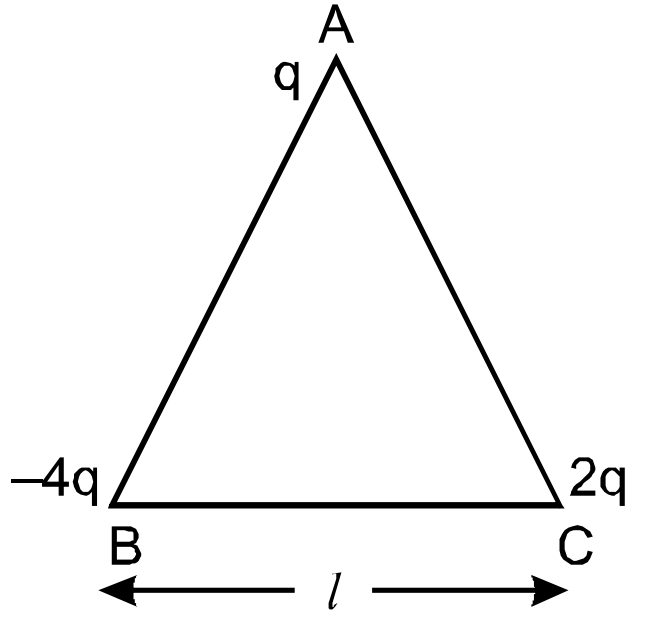
  1. Three point charges q, -4q and 2q are placed at the vertices of an equilateral triangle ABC of side ‘l’ as shown in the figure. Obtain the expression for the magnitude of the resultant electric force acting on the charge q.
  1. Find out the amount of the work done to separate the charges at infinite distance.