Question
A, B and C are all liquids. Liquid A has a comparatively low boiling point. On heating, liquid a vaporizes completely without leaving behind any residue. Liquid A is being used increasingly as a fuel in motor vehicles either alone or by mixing with petrol. Liquid B has a very high boiling point. It also vaporizes completely on heating, without leaving any residue. Liquid B is a conductor of electricity and used in making thermometers. Liquid c has a moderate boiling point. On heating, liquid C vaporises leaving behind a white solid D which is used in cooking vegetables. The condensation of vapours from C give a liquid E which turns anhydrous CuSO4 to blue.
  1. Which liquid could be an element? Name this element.
  2. Which liquid could be a mixture? Name this mixture.
  3. Which liquid could be a compound? Name this compound.
  4. What could the solid D be?
  5. What do you think is liquid E?

Answer

  1. Liquid B has a very high boiling point. It also vaporises on heating. It is a conductor of electricity and is used in making thermometers. So, B could be an element. Further, liquid B is mercury as mercury is a liquid metal, which expands on heating and is used extensively in thermometers.
  2. Liquid C has a moderate boiling point. It could be a mixture. It is a salt solution because when C is heated, it vaporises and leaves behind a white solid (salt), which is used in the process of cooking.
  3. Liquid A is used in motor vehicles as fuel, either alone or after mixing with petrol. It could be a compound because on heating, it does not leave any residue. It is alcohol as alcohol is being used in motor vehicles nowadays.
  4. Solid D is sodium chloride. It is also known as common salt and is added in food.
  5. Liquid E is water as, on heating, liquid C, which is a salt solution, leaves water vapours. On condensing these vapours, we obtain pure water. When water is mixed with anhydrous copper sulphate, we obtain a blue colour solution. This is because of the formation of hydrated copper sulphate solution.

$\text{CuSO}_4+5\text{H}_2\text{O}\xrightarrow{\ \ \ \ \ \ \ \ \ \ \ \ }\text{CuSO}_4\cdot5\text{H}_2\text{O}\\ \ \ \ \ \ \ \ \ \ \ \ \ \ \ \ \ \ \ \ \ \ \ \ \ \ \ \ \ \ \ \ \ \ \ \ \ \ {^\text{hydrated copper sulphate}}$

Need a full question paper?

Generate a complete, print-ready paper with questions like this in minutes — across 16+ boards, with answer keys.

Start Generating Free

Similar questions

Explain why antibiotics are more effective in curing bacterial disease than viral diseases?

In a reaction, 5.3g of sodium carbonate reacted with 6g of acetic acid. The products were 2.2g of carbon dioxide, 0.9g water and 8.2g of sodium Q acetate. Show that these observations are in agreement with the law of conservation of mass. sodium carbonate + acetic acid → sodium acetate + carbon dioxide + water.
An atom of an element X may be written as $^{9}_4\text{X} $
  1. What does the figure 9 indicate?
  2. What does the figure 4 indicate?
  3. What is the number of protons in atom X?
  4. What is the number of neutrons in atom X?
  5. What is the number of electrons in atom X?
  6. How many electrons are there in the outermost shell of an atom of element X?
  7. Write the symbol of ion formed by an element Z is 2, 8, 8.
Define motion. What do you understand by the terms ‘uniform motion’ and ‘non-uniform motion’? Explain with examples.

What is artificial insemination? Give its uses.

Name the following compounds. Also write the symbols/ formulae of the ions present in them:
  1. CuSO4
  2. (NH4)2SO4
  3. Na2O
  4. Na2CO3
  5. CaCl2

Suppose a planet exists whose mass and radius both are half those of the earth. Calculate the acceleration due to gravity on the surface of this planet.

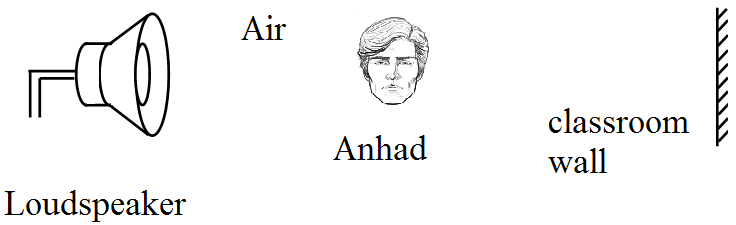
In an experiment, Anhad studies sound waves. He sets up a loudspeaker to produce sound as shown below:

Anhad adjusts the signal to the loudspeaker to give a sound of frequency 200Hz.

  1. What happens to the air in-between Anhas and the loudspeaker?
  2. Explain how Anhad receives sound in both ears.
Explain the structure of neuron with the help of a labelled diagram
Pragya tested the solubility of three different substances at different temperatures and collected the data as given below (results are given in the following table, as grams of substance dissolved in 100 grams of water to form a saturated solution).
Substance Dissolved  Temperature in K
283 293 313 333 353
Solubility
Potassium nitrate 21 32 62 106 167
Sodium chloride 36 36 36 37 37
Potassium chloride 35 35 40 46 54
Ammonium chloride 24 37 41 55
66
  1. What mass of potassium nitrate would be needed to produce a saturated solution of potassium nitrate in 50 grams of water at 313K?
  2. Pragya makes a saturated solution of potassium chloride in water at 353K and leaves the solution to cool at room temperature. What would she observe as the solution cools? Explain.
  3. Find the solubility of each salt at 293K. Which salt has the highest solubility at this temperature?
  4. What is the effect of change of temperature on the solubility of a salt?