MCQ
$(a-b)^3+(b-c)^3+(c-a)^3=$
  • A
    $(a+b+c)\left(a^2+b^2+c^2-a b-b c-c a\right)$
  • B
    $(a-b)(b-c)(c-a)$
  • $3(a-b)(b-c)(c-a)$
  • D
    none of these

Answer

Correct option: C.
$3(a-b)(b-c)(c-a)$
c

Need a full question paper?

Generate a complete, print-ready paper with questions like this in minutes — across 16+ boards, with answer keys.

Start Generating Free

Similar questions

The coefficient of $x^2$ in the expansion of $(x + 3)^4$ is:
The mean of $100$ items was found to be $64.$ Later on it was discovered that two items were misread as $26$ and $9$ instead of $36$ and $90$ respectively. The correct mean is:
The region between chord and either of the arc is called.
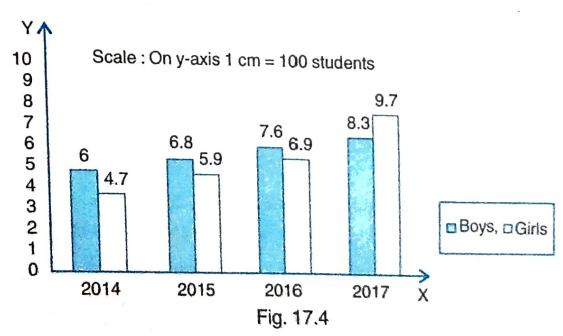
Figure 17.4, shows the bar graph of number of boys and number of girls in a school from 2014 to 2017.
Image
In which year the difference between the number of boys and the number of girls was more
Write the correct answer in the following: A grouped frequency distribution table with classes of equal sizes using $63-72 (72$ included$)$ as one of the class is constructed for the following data: $30, 32, 45, 54, 74, 78, 108, 112, 66, 76, 88, 40, 14, 20, 15, 35, 44, 66, 75, 84, 95, 96, 102, 110, 88, 74, 112, 14, 34, 44.$ The number of classes in the distribution will be:
If $\text{x}^3+\frac{1}{\text{x}^3}=110,$ then $\text{x}+\frac{1}{\text{x}}=$
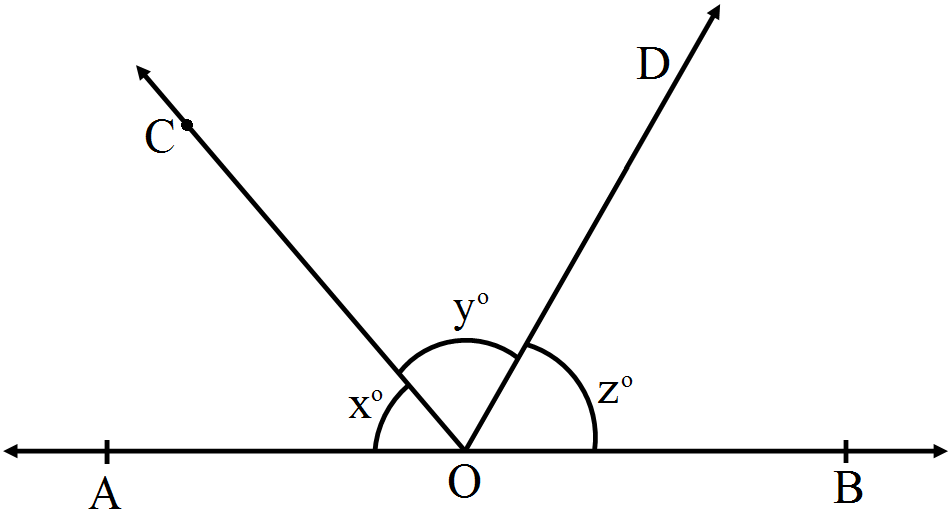
In the adjoining figure, $AOB$ is a straight line. If $x : y : z = 4 : 5 : 6$, then $y =?$
The quadrilateral formed by joining the points A (0, 0), B (5, 0), C (3, 2) and D (0, 2) in order is a
When two straight lines intersect:
$i$. Adjacent angles are complementary
$ii$. Adjacent angles are supplementary.
$iii$. Opposite angles are equal.
$iv$. Opposite angles are supplementary.
Of these statements:
What is the length of $PQ$ in a trapezium $ABCD$ in which $\text{AB || DC}$ and P and Q are mid-points on $AD$ and $BC$ respectively?