MCQ
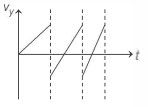
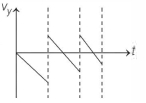
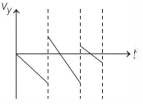
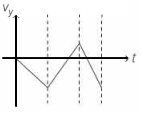
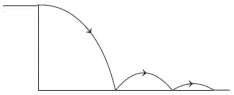
A ball is thrown horizontally from a height with a certain initial velocity at time $t=0$. The ball bounces repeatedly from the ground with the coefficient of restitution less than $1$ as shown below. Neglecting air resistance and taking the upward direction as positive, which figure qualitatively depicts the vertical component of the ball's velocity $v_y$ as a function of time $t$ ?
  • A


  • C

  • D

Answer

Correct option: B.

b
(b)

When ball is released, vertical component of ball's velocity first increases in negative direction (downwards), then on collision with floor, its velocity is reversed (upwards).

As acceleration remains constant, so lines are parallel to each other as given in option $(b)$.

Need a full question paper?

Generate a complete, print-ready paper with questions like this in minutes — across 16+ boards, with answer keys.

Start Generating Free

Similar questions

A block of ice at $-20\,^oC$ having a mass of $2\, kg$ is added to a $3\, kg$ water at $15\,^oC$. Neglecting heat losses and the heat capacity of the container
The specific heat of alcohol is about half that of water. Suppose you have identical masses of alcohol and water. The alcohol is initially at temperature $T_A$ . The water is initially at a different temperature $T_W$ . Now the two fluids are mixed in the same container and allowed to come into thermal equilibrium, with no loss of heat to the surroundings. The final temperature of the mixture will be 
$1kWh = $
A cubical block of side $'a'$ and density $'\rho '$ slides over a fixed inclined plane with constant velocity $'v'$ . There is a thin film of viscous fluid of thickness $'t'$ between the plane and the block. Then the coefficient of viscosity of the thin film will be
A satellite is in an elliptical orbit around a planet $P.$ It is observed that the velocity of the satellite when it is farthest from the planet is $6$ time less than that when it is closest to the planet. The ratio of distances between the satellite and the planet at closest and farthest points is$......$
The period of oscillation of a mass $M$ suspended from a spring of negligible mass is $T$. If along with it another mass $M$ is also suspended , the period of oscillation will now be
$Assertion :$ In pressure-temperature $(P-T)$ phase diagram of water, the slope of the melting curve is found to be negative.
$Reason :$ Ice contracts on melting to water.
Which of the following is different from others
The $K.E.$ of a body can be increased maximum by doubling its:
During blood transfusion the needle is inserted in a vein where the gauge pressure is $2000 \;Pa$. At what height (in $m$) must the blood container be placed so that blood may just enter the vein ?

Density of whole blood, $\rho=1.06 \times 10^{3} \;kg m ^{-3}$