Question
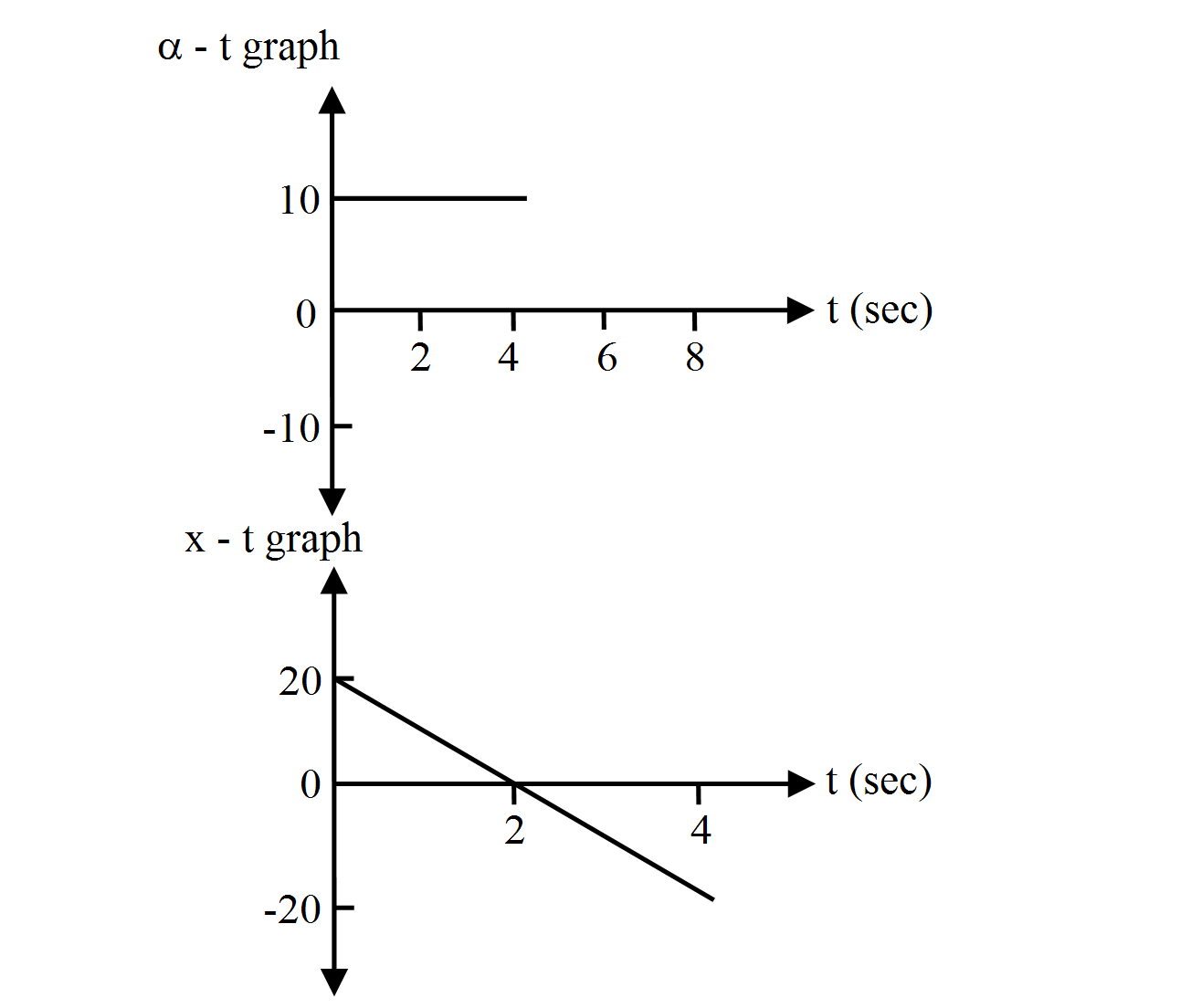
A ball is thrown vertically up with a velocity of 20m/s. Construct acceleration time and displacement time graph.

Answer

$\mathrm{u}=20 \mathrm{~ms}^{-1}, \mathrm{a}=\mathrm{gms}^{-2}$ Time to reach the highest point, $\text{t}=\frac{\text{u}}{\text{g}}=2\text{ seconds}.$ Max. height $=\frac{1}{2}\text{g}\times4=20\text{m}$

Need a full question paper?

Generate a complete, print-ready paper with questions like this in minutes — across 16+ boards, with answer keys.
Start Generating Free

Similar questions

Why does a girl have to lean towards right when carrying a bag in her left hand?
Find the average magnitude of linear momentum of a helium molecule in a sample of helium gas at $0^{\circ} \mathrm{C}$. Mass of a helium molecule $=6.64 \times 10^{-27} \mathrm{~kg}$ nd Boltzmann constant $=1.38 \times 10^{-23} \mathrm{JK}^{-1}$.
Two tuning forks vibrate with the same amplitude but the frequency of the first is double the frequency of the second. Which fork produces more intense sound in air?
At what temperature will the root mean square velocity of helium molecules be half the root mean square velocity of hydrogen molecules at normal temperature and pressure?
A spherical shell is heated. The volume change according to the equation $\text{V}_\theta=\text{V}_\theta(1+\gamma\theta)$. Does the volume refer to the volume enclosed by the shell or the volume of the material making up the shell?
Two bodies are thrown with same velocities at angles $\alpha$ and $(90^\circ-\alpha)$ with the horizontal. What will be the ratio of $(i)$ maximum heights attained by them $(ii)$ their horizontal ranges?
Near the bank of a river the velocity of water is less but is more in the centre, why?
The SI unit of energy is $J = kg m ^2 s ^{-2}$; that of speed $v$ is $m s ^{-1}$ and of acceleration $a$ is $m s ^{-2}$. Which of the formulae for kinetic energy ( $K$ ) given below can you rule out on the basis of dimensional arguments ( $m$ stands for the mass of the body) :
(a) $K=m^2 v^3$
(b) $K=(1 / 2) m v^2$
(c) $K=m a$
(d) $K=(3 / 16) mv ^2$
(e) $K=(1 / 2) m v^2+m a$
The time of flight of a projectile is $T$ and horizontal range is $R$. What will be the projectile angle?Or The time of flight is $T$ and horizontal range is $R$ of a projectile. Prove that the angle of projection of a projectile is $\theta=\tan ^{-1}\left(\frac{g T^2}{2 R}\right)$.
The masses M in the two figures are identical. Which of the two systems has the smaller gravitational potential energy? Why?