Question
A baloon filled with helium rises against gravity increasing its potential energy. The speed of the baloon also increases as it rises. How do you reconcile this with the law of conservation of mechanical energy? You can neglect viscous drag of air and assume that density of air is constant.
Answer

As the dragging viscous force of air on balloon is neglected so there is Net Buoyant Force = Vpg = Volume of air displaced × net density upward × g$=\text{V}(\text{p}_{\text{air}}-\text{p}_\text{He})\text{g}(\text{upward})$
Let a be the upward acceleration on balloon then,$\text{ma}=\text{V}(\text{p}_{\text{air}}-\text{p}_\text{He})\text{g}\ ...(\text{i})$
V = Volume of air displacement by balloon = Volume of balloon $p_{air}$ = density of air $p_{He}$ = density of helium$\text{m}\frac{\text{dv}}{\text{dt}}=\text{V}(\text{p}_{\text{air}}-\text{p}_\text{He})\text{g}$
$\text{m dv}=\text{V}(\text{p}_{\text{air}}-\text{p}_\text{He})\text{g}\cdot\text{dt}$
Integrating both sides $\text{mv}=\text{V}(\text{p}_{\text{air}}-\text{p}_\text{He})\text{gt}$$\text{v}=\frac{\text{V}}{\text{m}}(\text{p}_{\text{air}}-\text{p}_\text{He})\text{gt}$
KE of balloon $=\frac{1}{2}\text{mv}^2$$\frac{1}{2}\text{mv}^2=\frac{1}{2}\text{m}\frac{\text{v}^2}{\text{m}^2}(\text{p}_{\text{air}}-\text{p}_\text{He})^2\text{g}^2\text{t}^2$
$=\frac{\text{V}^2}{2\text{m}}(\text{p}_{\text{air}}-\text{p}_\text{He})^2\text{g}^2\text{t}^2\ ....(\text{ii})$
If the balloon rises to a height h, from (i)$\text{a}=\frac{\text{V}}{\text{m}}(\text{p}_{\text{air}}-\text{p}_\text{He})\text{g}$
$\text{h}=\text{ut}+\frac{1}{2}\text{at}^2=0\cdot\text{t}+\frac{1}{2}\Big[\frac{\text{V}}{\text{m}}(\text{p}_\text{air}-\text{p}_\text{He})\Big]\text{t}^2$
$\therefore\ \text{h}=\frac{\text{V}}{2\text{m}}(\text{p}_\text{air}-\text{p}_\text{he})\text{gt}^2\ ...(\text{iii})$
From (ii) and (iii) rearranging the terms of (ii) according to h in (iii)$\frac{1}{2}\text{mv}^2=\Big\{\frac{\text{V}}{2\text{m}}(\text{p}_\text{air}-\text{p}_\text{He})\text{gt}^2\Big\}\cdot\text{V}(\text{p}_\text{air}-\text{p}_{\text{He}})\text{g}$
$\frac{1}{2}\text{mv}^2=\{\text{h\}}\cdot\text{V}(\text{p}_\text{air}-\text{p}_{\text{He}})\text{g}$
$\frac{1}{2}\text{mv}^2=\text{V}\cdot(\text{p}_\text{air}-\text{p}_{\text{He}})\text{gh}$
$\frac{1}{2}\text{mv}^2=\text{V}\text{p}_\text{air}\text{gh}-\text{V}\text{p}_{\text{He}}\text{gh}$
$\frac{1}{2}\text{mv}^2+\text{p}_{\text{He}}\text{Vgh}=\text{p}_\text{air}\text{Vgh}$
$\text{KE}_{\text{ballon}}+\text{PE}_{\text{ballon}}=\text{Changein PE of air}$
So, as the balloon goes up, an equal volume of air comes down, increases in PE and KE of the balloon is at cost of PE of air (which comes down).

Need a full question paper?

Generate a complete, print-ready paper with questions like this in minutes — across 16+ boards, with answer keys.

Start Generating Free

Similar questions

A motorcycle has to move with a constant speed on an overbridge which is in the form of a circular arc of radius R and has a total length L. Suppose the motorcycle starts from the highest point.
  1. What can its maximum velocity be for which the contact with the road is not broken at the highest point?
  2. If the motorcycle goes at speed $\frac{1}{\sqrt2}$ times the maximum found in part (a), where will it lose the contact with the road?
  3. What maximum uniform speed can it maintain on the bridge if it does not lose contact anywhere on the bridge?
A stone of mass m is tied to an elastic string of negligble mass and spring constant k. The unstretched length of the string is L and has negligible mass. The other end of the string is fixed to a nail at a point P. Initially the stone is at the same level as the point P. The stone is dropped vertically from point P.
  1. Find the distance y from the top when the mass comes to rest for an instant, for the first time.
  2. What is the maximum velocity attained by the stone in this drop?
  3. What shall be the nature of the motion after the stone has reached its lowest point?
Suppose all the electrons of 100g water are lumped together to form a negatively charged particle and all the nuclei are lumped together to form a positively charged particle. If these two particles are placed 10.0cm away from each other, find the force of attraction between them. Compare it with your weight.
Mathematically describe the motion of a particle along a plane (or along a two-dimensional plane).
Separation of Motion of a system of particles into motion of the centre of mass and motion about the centre of mass: Show $\frac{\text{dL}}{\text{dt}}=\sum\text{r}'_\text{i}\times\frac{\text{dp}'}{\text{dt}}$ Further, show that $\frac{\text{dL}'}{\text{dt}}=\tau'_\text{ext}$ where $\tau'_\text{ext}$ is the sum of all external torques acting on the system about the centre of mass. (Hint: Use the definition of centre of mass and third law of motion. Assume the internal forces between any two particles act along the line joining the particles)
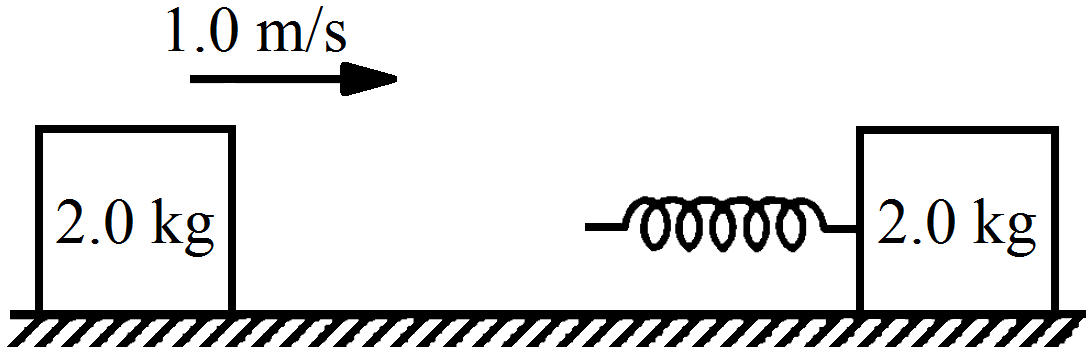
A block of mass 2.0kg is moving on a frictionless horizontal surface with a velocity of 1.0m/s towards another block of equal mass kept at rest. The spring constant of the spring fixed at one end is 100N/m. Find the maximum compression of the spring.
Two masses $M_1$ and $M_2$ are connected by a light rod and the system is slipping down a rough incline of angle $\theta$ with the horizontal. The friction coefficient at both the contacts is $\mu.$ Find the acceleration of the system and the force by the rod on one of the blocks.
An object is moving along $x-$axis in such a way that its displacement is given by $x = 30 + 20t^2$
where $x$ is in metres and $t$ is in seconds.
  1. Find the velocity and acceleration.
  2. What are the initial position and the velocity of the object?
State Kepler's laws of planetary motion. What would be the speed of rotation of the earth in order that a body on the equator has no weight? Determine the apparent weights of the bodies situated at a latitude of $60°$ and at the poles. The radius of the earth = $6400km$ and $g = 9.8ms^{-1}$.
A pebble of mass $0.05kg$ is thrown vertically upwards. Give the direction and magnitude of the net force on the pebble,
  1. During its upward motion
  2. During its downward motion.
  3. At the highest point where it is momentarily at rest. Do your answers change if the pebble was thrown at an angle of $45°$ with the horizontal direction? Ignore air resistance.