Question
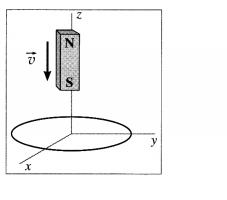
A bar magnet is dropped vertically through a thick copper ring as shown. What is the direction of the force exerted by the coil on the magnet? Explain.
Image

Answer

The magnetic flux through the loop increases when the magnet approaches the loop, and decreases after the magnet has passed through. The induced current in the loop opposes the cause producing the change in flux which, in this case, is the falling magnet. Therefore, the motion of the magnet’ is opposed, first with a repulsion and then with an attraction. The force, in both cases, is upward in the + z-direction.
The magnetic dipole moment of the falling magnet is directed up. Therefore, looking down the z-axis, the induced current is clockwise when the magnet is approaching the loop, so that the magnetic moment of the loop points down; subsequently, as the magnet recedes, the induced current is anticlockwise.
Need a full question paper?

Generate a complete, print-ready paper with questions like this in minutes — across 16+ boards, with answer keys.

Start Generating Free

Similar questions

What are the steps through which a refrigerant goes in one complete cycle of refrigeration?
Write a note on thermodynamic equilibrium.
A current of $10 A$ passes through a coil having $5$ tums and produces a magnetic field of magnitude $0.5 \times 10^{-4} T$ at the centre of the coil. Calculate the diameter of the coil.
How does the frequency of an SHM vary with
1. the force constant $k$
2. the mass of the particle performing SHM ?
In Young's double-slit experiment, the second minimum in the interference pattern is exactly in front of one slit. The distance between the two slits is $d$ and that between the source and screen is $D$. What is the wavelength of the light used?
galvanometer has a resistance of \(16 \Omega\). It shows full scale deflection, when a current of \(20 mA\) is passed through it. The only shunt resistance available is \(0.06 \Omega\) which is not appropriate to convert a galvanometer into an ammeter. How much resistance should be connected in series with the coil of the galvanometer, so that the range of ammeter is \(8 A\) ?
State the principle of working of a moving- coil galvanometer (suspended-coil type).
The minimum angular separation between two stars is $4 \times 10^6 rad$ when a telescope is used to observe them with an objective of aperture $16 cm$. Find the wavelength of the light.
A parallel$-$plate air capacitor has rectangular plates, each of area $20 \ cm ^2$ separated by a distance of $2 \ mm$. The potential difference between the plates is $500$ volts. Calculate $(i)$ its capacitance $(ii)$ the charge on each plate $(iii)$ the electric field intensity between the two plates.
Explain why the inductance of two coils connected in parallel is less than the inductance of either coil.