Question
A bar magnet makes 40 oscillations per minute in an oscillation magnetometer. An identical magnet is demagnetized completely and is placed over the magnet in the magnetometer. Find the time taken for 40 oscillations by this combination. Neglect any induced magnetism.

Answer

$\gamma_1=40$ oscillations/minute

$\text{B}=25\mu\text{T}$

M of second magnet $=1.6\text{A-m}^2$

$\text{d}=20\text{cm}=0.2\text{m}$

  1. For north facing north.

$\gamma=\frac{1}{2\pi}\sqrt{\frac{\text{MB}_\text{H}}{\text{I}}}$

$\gamma=\frac{1}{2\pi}\sqrt{\frac{\text{M}(\text{B}_\text{H}-\text{B})}{\text{I}}}$

$\text{B}=\frac{\mu_0}{4\pi}\frac{\text{m}}{\text{d}^3}=\frac{10^{-7}\times1.6}{8\times10^{-3}}=20\mu\text{T}$

$\frac{\gamma_1}{\gamma_2}=\sqrt{\frac{\text{B}}{\text{B}_\text{H}-\text{B}}}\Rightarrow\frac{40}{\gamma _2}=\sqrt{\frac{25}{5}}$

$\Rightarrow\gamma_2=\frac{40}{\sqrt{5}}=17.88\approx \text{osci/min}$

  1. For north pole facing south.

$\gamma_1 =\frac{1}{2\pi}\sqrt{\frac{\text{MB}_\text{H}}{\text{I}}}$

$\gamma_2=\frac{1}{2\pi}\sqrt{\frac{\text{M} (\text{B} _\text{H}-\text{B}}{\text{I}}}$

$\frac{\gamma_1}{\gamma_2}=\sqrt{\frac{\text{B}}{\text{B}_\text{H}-\text{B}}}\Rightarrow\frac{40}{\gamma_2}=\sqrt{\frac{25}{45}}$

$\Rightarrow\gamma_2=\frac{40}{\sqrt{\big(\frac{25}{45}\big)}}=53.66\approx54\text{ osci/min}$
Need a full question paper?

Generate a complete, print-ready paper with questions like this in minutes — across 16+ boards, with answer keys.

Start Generating Free

Similar questions

When a monochromatic radiations of suitable frequency obtained from source S, after being filtered by a filter attached on the window W, fall on the photosensitive place C, the photo electrons are emitted from C, which get accelerated towards the plate A if it is kept at positive potential. These electrons flow in the outer circuit resulting in photoelectric current. Due to it, the microammeter shows a deflection. The reading of micrommeter measures the photoelectric current.

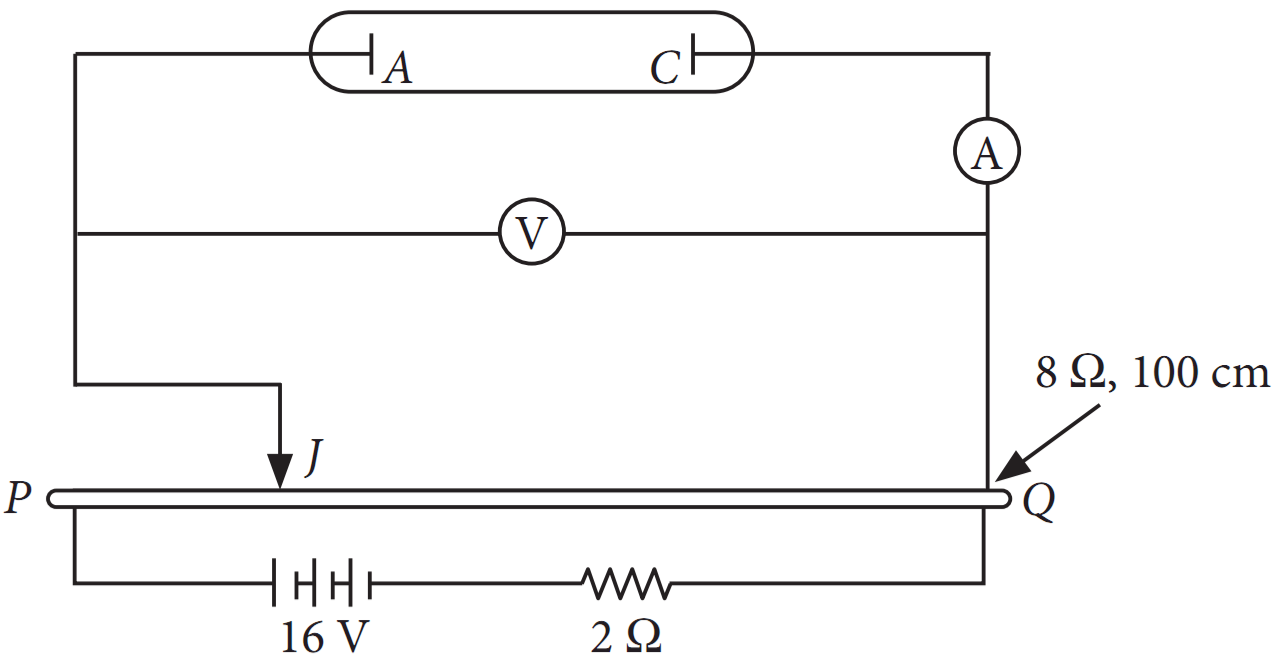
An experimental setup of verification of photoelectric effect is shown in figure. The voltage across the electrodes is measured with the help ofan ideal voltmeter, and which can be varied by moving jockey Jon the potentiometer wire. The battery used in potentiometer circuit is of 16 V and its internal resistance is $2\Omega$. The resistance of 100cm long potentiometer wire is $8\Omega$.

The photocurrent is measured with the help of an ideal ammeter. Two plates of potassium oxide of area 50cm2 at separation 0.5mm are used in the vacuum tube. Photocurrent in the circuit is very small, so we can treat the potentiometer circuit as an independent circuit.

Light
1 Violet
2 Blue
3 Green
4 Yellow
5 Orange
6 Red
$\lambda(\text{in } \mathring{\text{A}})$
4000-500
4500-5000
5000-5500
5500-6000
6000-6500
6500-7000
  1. When radiation falls on the cathode plate, a current of $2\mu\text{A}$ is recorded in the ammeter. Assuming that the vacuum tube setup follows Ohm's law, the equivalent resistance of vacuum tube operating in the case when jockey is at end P is:

  1. $8\times10^8\Omega$

  2. $16\times10^6\Omega$

  3. $8\times10^6\Omega$

  4. $10\times10^6\Omega$

  1. It is found that ammeter current remains unchanged $(2\mu\text{A})$ even when the jockey is moved from the end P to the middle point of the potentiometer wire. Assuming that all the incident photons eject electrons and the power of the light incident is $4\times10^{-6}\Omega$. Then, the color of the incident light is:

  1. Green
  2. Violet
  3. Red
  4. Orange
  1. Which of the following colors may not give photoelectric effect for this cathode?
  1. Green
  2. Violet
  3. Red
  4. Orange
  1. When other light falls on the anode plate, the anuneter reading zero till jockey is moved from the end P to the middle point of the wire PQ. Therefore, the deflection is recorded in the anuneter. The maximum kinetic energy of the emitted electron is:
  1. 16eV
  2. 8eV
  3. 4eV
  4. 10eV
  1. If the intensity of incident radiation is increased twice, the number of photoelectrons emitted per second will be:
  1. Halves
  2. Double
  3. Remain same
  4. Four times
A magnetic needle is free to rotate in a vertical plane which makes an angle of 60° with the magnetic meridian. If the needle stays in a direction making an angle of $\tan^{-1}\Big(\frac{2}{\sqrt{3}}\Big)$ with the horizontal, what would be the dip at that place?
A silver ball of radius 4.8cm is suspended by a thread in a vacuum chamber. Ultraviolet light of wavelength 200 run is incident on the ball for some time during which a total light energy of 1.0 × 10⁻⁷J falls on the surface. Assuming that on the average one photon out of every ten thousand is able to eject a photoelectron, find the electric potential et the surface of the bell assuming zero potential at infinity. What is the potential at the centre of the bell?
In the study of Geiger-Marsdon experiment on scattering of α  particles by a thin foil of gold, draw the trajectory ofα−particles in the Coulomb field of target nucleus. Explain briefly how one gets the information on the size of the nucleus from this study. From the relation R = R0 A1/3, where R0 is constant and A is the mass number of the nucleus, show that nuclear matter density is independent of A.
To convert two atoms into ions, 2 electrons have been removed from each of them. When these ions are placed in a vacuum, they repel each other with a force of $3.7 \times 10^{-9}$ Newton. Find the distance between them.
A magnetic dipole of magnetic moment 0.72A-m2 is placed horizontally with the north pole pointing towards bsouth. Find the position of the neutral point if the horizontal component of the earth's magnetic field is $18\mu\text{T.}$
A charge of $1.6 \times 10^{-7} C$ is uniformly distributed on the surface of a spherical conductor of radius 12 cm . What will be the electric field?(a) Inside the sphere(b) Just outside the sphere(c) At any point located 18 cm from the centre of the sphere.
Two long bar magnets are placed with their axes coinciding in such a way that the north pole of the first magnet is 2·0cm from the south pole of the second. If both the magnets have a pole strength of 10A-m, find the force exerted by one magnet on the other.
The radio and TV programmes, telecast at the studio, reach our antenna by wave motion. Is it a mechanical wave or nonmechanical?
Suppose while sitting in a parked car, you notice a jogger approaching towards you in the side view mirror of $R =2 m$. If the jogger is running at a speed of $5 ms^1$, how fast the image of the jogger appear to move when the jogger is (a) 39 m , (b) 29 m, (c) 19 m , and(d) 9 m away.