Question
A bar magnet makes 40 oscillations per minute in an oscillation magnetometer. An identical magnet is demagnetized completely and is placed over the magnet in the magnetometer. Find the time taken for 40 oscillations by this combination. Neglect any induced magnetism.

Answer

$\gamma_1=40$ oscillations/minute$\text{B}=25\mu\text{T}$
M of second magnet $=1.6\text{A-m}^2$
$\text{d}=20\text{cm}=0.2\text{m}$
  1. For north facing north.
$\gamma=\frac{1}{2\pi}\sqrt{\frac{\text{MB}_\text{H}}{\text{I}}}$
$\gamma=\frac{1}{2\pi}\sqrt{\frac{\text{M}(\text{B}_\text{H}-\text{B})}{\text{I}}}$
$\text{B}=\frac{\mu_0}{4\pi}\frac{\text{m}}{\text{d}^3}=\frac{10^{-7}\times1.6}{8\times10^{-3}}=20\mu\text{T}$
$\frac{\gamma_1}{\gamma_2}=\sqrt{\frac{\text{B}}{\text{B}_\text{H}-\text{B}}}\Rightarrow\frac{40}{\gamma _2}=\sqrt{\frac{25}{5}}$
$\Rightarrow\gamma_2=\frac{40}{\sqrt{5}}=17.88\approx \text{osci/min}$
  1. For north pole facing south.
$\gamma_1 =\frac{1}{2\pi}\sqrt{\frac{\text{MB}_\text{H}}{\text{I}}}$
$\gamma_2=\frac{1}{2\pi}\sqrt{\frac{\text{M} (\text{B} _\text{H}-\text{B}}{\text{I}}}$
$\frac{\gamma_1}{\gamma_2}=\sqrt{\frac{\text{B}}{\text{B}_\text{H}-\text{B}}}\Rightarrow\frac{40}{\gamma_2}=\sqrt{\frac{25}{45}}$
$\Rightarrow\gamma_2=\frac{40}{\sqrt{\big(\frac{25}{45}\big)}}=53.66\approx54\text{ osci/min}$

Need a full question paper?

Generate a complete, print-ready paper with questions like this in minutes — across 16+ boards, with answer keys.

Start Generating Free

Similar questions

The power delivered in the plate circular of a diode is 1.0W when the plate voltage is 36V. Find the power delivered if the plate voltage is increased to 49V. Assume Langmuir-Child equation to hold.
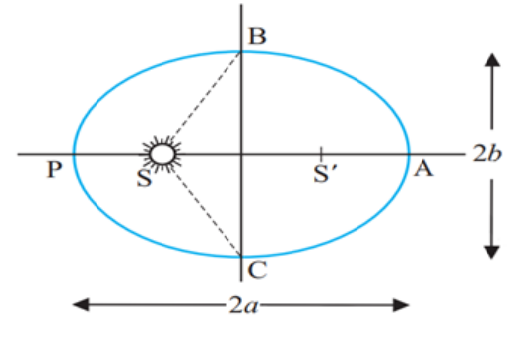
Read the passage given below and answer the following questions from 1 to 5. LAW OF ORBIT: The orbit of every planet is an ellipse around the sun with sun at one of the two foci of ellipse.
LAW OF AREAS: The line that joins a planet to the sun sweeps out equal areas in equal intervals of time. Area covered by the planet while revolving around the sun will be equal in equal intervals of time. This means the rate of change of area with time is constant. LAW OF PERIOD: According to this law the square of time period of a planet is directly proportional to the cube of the semi-major axis of its orbit. Suppose earth is revolving around the sun then the square of the time period (time taken to complete one revolution around sun) is directly proportional to the cube of the semi major axis. It is known as Law of Periods as it is dependent on the time period of planets. Answer the following.
  1. Keplers second law is knows as:
  1. Law of period
  2. Law of area
  3. Law of gravity
  4. None of these
  1. Keplers third law is knows as:
  1. Law of period
  2. Law of area
  3. Law of gravity
  4. None of these
  1. The velocity of a planet is constant throughout its elliptical trajectory in an orbit.
  1. True
  2. False
  3. None of these
  1. State Kepler’s second law of planetary motion.
  1. Two objects of masses $5kg$ and $10 kg$ separated by distance 10m. What is gravitational force between them?
What can be said about the centre of mass of a uniform hemisphere without making any calculation? Will its distance from the centre be more than $\frac{\text{r}}{2}$ or less than $\frac{\text{r}}{2}?$
The needle of a dip circle shows an apparent dip of 45° in a particular position and 53° when the circle is rotated through 90°. Find the true dip.
Read the passage given below and answer the following questions from 1 to 5. Newton’s first law of motion states that If the net external force on a body is zero, its acceleration is zero. Acceleration can be non zero only if there is a net external force on the body. To summaries, if the net external force is zero, a body at rest continues to remain at rest and a body in motion continues to move with a uniform velocity. This property of the body is called inertia. Inertia means ‘resistance to change’. A body does not change its state of rest or uniform motion, unless an external force compels it to change that state. In other words, all objects resist a change in their state of motion. In a qualitative way, the tendency of undisturbed objects to stay at rest or to keep moving with the same velocity is called inertia. Consider a book at rest on a horizontal surface. It is subject to two external forces: the force due to gravity (i.e. its weight W) acting downward and the upward force on the book by the table, the normal force R. R is a self-adjusting force. This is an example of the kind of situation mentioned above. The forces are not quite known fully but the state of motion is known. We observe the book to be at rest. Therefore, we conclude from the first law that the magnitude of R equals that of W. A statement often encountered is : Since W = R, forces cancel and, therefore, the book is at rest”. This is incorrect reasoning. The correct statement is: “Since the book is observed to be at rest, the net external force on it must be zero, according to the first law. This implies that the normal force R must be equal and opposite to the weight W.
  1. The book on table is at rest. The force of gravity here is balanced by:
  1. Force of friction.
  2. Normal reaction by table on book.
  3. Weight of table.
  4. None of these.
  1. If no external force acts on object which is at rest. it will
  1. Remain at rest.
  2. Start to move.
  3. Both a and b can possible.
  4. None of these.
  1. Define inertia.
  1. State Newton’s first law of motion.
  1. Explain why book on table remains at rest.
Mr. Verma $(50kg)$ and Mr. Mathur $(60kg)$ are sitting at the two extremes of a $4m$ long boat $(40kg)$ standing still in water. To discuss a mechanics problem, they come to the middle of the boat. Neglecting friction with water, how far does the boat move on the water during the process?
Read the passage given below and answer the following questions from 1 to 5. Every measurement involves errors. Thus, the result of measurement should be reported in a way that indicates the precision of measurement. Normally, the reported result of measurement is a number that includes all digits in the number that are known reliably plus the first digit that is uncertain. The reliable digits plus the first uncertain digit are known as significant digits or significant figures. If we say the period of oscillation of a simple pendulum is 1.62 s, the digits 1 and 6 are reliable and certain, while the digit 2 is uncertain. Thus, the measured value has three significant figures.A choice of change of different units does not change the number of significant digits or figures in a measurement. This important remark makes most of the following observations clear,
  • All the non-zero digits are significant.
  • All the zeros between two non-zero digits are significant, no matter where the decimal point is, if at all.
  • If the number is less than 1, the zero(s) on the right of decimal point but to the left of the first non-zero digit are not significant.
  • The terminal or trailing zero(s) in a number without a decimal point are not significant.[Thus 123 m = 12300 cm = 123000 mm has three significant figures, the trailing zero(s) being not significant.
  • The trailing zero(s) in a number with a decimal point are significant. [The numbers 3.500 or 0.06900 have four significant figures each]
  • For a number greater than 1, without any decimal, the trailing zero(s) are not significant.
  • For a number with a decimal, the trailing zero(s) are significant
(b) The digit 0 conventionally put on the left of a decimal for a number less than 1 (like 0.1250) is never significant. However, the zeroes at the end of such number are significant in a measurement. (c) The multiplying or dividing factors which are neither rounded numbers nor numbers representing measured values are exact and have infinite number of significant digits. (d) In multiplication or division, the final result should retain as many significant figures as are there in the original number with the least significant figures.In addition or subtraction, the final result should retain as many decimal places as are there in the number with the least decimal places. For example, the sum of the numbers 436.32 g, 227.2 g and 0.301 g by mere arithmetic addition, is 663.821 g. But the least precise measurement (227.2 g) is correct to only one decimal place. The final result should, therefore, be rounded off to 663.8 g.
  1. Significant figures in 12300 cm are:
  1. 5
  2. 4
  3. 3
  4. None of these
  1. All the non-zero digits are:
  1. Significant
  2. Non significant
  3. None of these
  1. Give rules for significant figures
  1. Give rules for addition and subtraction operations with significant figure
  1. Give rules for multiplication and division operations with significant figure
If a mosquito is dipped into water and released, it is not able to fly till it is dry again. Explain.
Read the passage given below and answer the following questions from 1 to 5.In physics, we can classify quantities as scalars or vectors. Basically, the difference is that a direction is associated with a vector but not with a scalar. A scalar quantity is a quantity with magnitude only. It is specified completely by a single number, along with the proper unit. Examples are: the distance between two points, mass of an object, the temperature of a body and the time at which a certain event happened. The rules for combining scalars are the rules of ordinary algebra. Scalars can be added, subtracted, multiplied and divided just as the ordinary numbers. A vector quantity is a quantity that has both a magnitude and a direction and obeys the triangle law of addition or equivalently the parallelogram law of addition. So, a vector is specified by giving its magnitude by a number and its direction. Some physical quantities that are represented by vectors are displacement, velocity, acceleration and force. Answer the following
  1. Force is example of:
  1. Scalar
  2. Vector
  3. Tensor
  4. None of these
  1. Mass of an object is:
  1. Scalar
  2. Vector
  3. Tensor
  4. None of these
  1. Define scalar quantity and vector quantity
  1. Can we add vectors like ordinary algebra? If not then how vectors are added?
  1. Differentiate between scalar and vectors
A diode value is connected to a battery and a load resistance. The filament is heated, so that a constant current is obtained in the circuit. As the cathode continuously emits electrons, does it become more and more positively charged?